

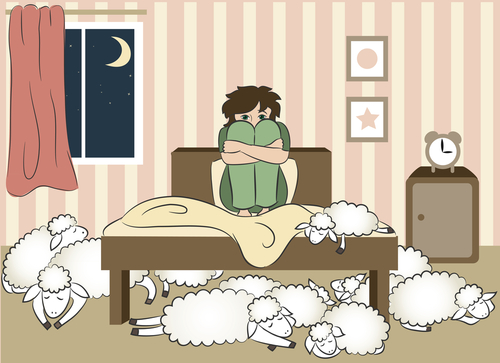

A bad night’s sleep can make the next day feel as if it should end before it has even begun. Most people (without young children or exams looming) can catch up on the occasional restless night pretty well, but roughly 30% of people live with a persistent difficulty falling asleep or maintaining sleep called insomnia. Up to 10% of people report impairment in their daily function as a result of insomnia which can contribute to poor physical health, decreased work performance and increase in the risk of accidents.
Insomnia is also associated with mental health problems; 80-90% of people with depression/anxiety suffer from insomnia and those with chronic insomnia are twice as likely to become depressed.
Cognitive Behavioural Therapy for insomnia (CBTi) has a strong evidence base for treating insomnia in the absence of co-morbid physical and mental health health problems (Riemann et al, 2009).
There have also been a few small randomised controlled trials (RCTs) examining its effectiveness for improving sleep and mental health outcomes in psychiatric populations. The recent systematic review (Taylor et al, 2014) that pulls together these studies is the subject of this blog.

Methods
The authors used a fairly broad search strategy to identify RCTs that compared active CBTi components to a control, usually a waiting list. They only searched the PubMed and PyschInfo databases, so it’s possible that they may have missed studies published and indexed elsewhere (e.g. the Embase database).
The most commonly identified outcome measure for sleep was self-report sleep efficiency from sleep diaries (total sleep time/time in bed x 100) but studies using insomnia severity questionnaires were also included. Other outcomes measured (where validated measures were included) were depression, anxiety, post traumatic stress disorder (PTSD), alcohol use and hypnotic usage. Studies were excluded if they did not use these measures, if the intervention was sleep hygiene alone, or if their participants suffered with a co-morbid medical condition.
Results
16 studies including 571 participants were included. There was huge variability between the CBTi component examined, the number of sessions delivered, the type of co-morbid psychiatric disorder present and outcome variables measured in these studies.
Sleep outcomes
- For patients with any of the co-morbid psychiatric disorders examined, CBTi had a medium to large effect on:
- Sleep efficiency (effect size 0.76 , 95% CI: 0.56 to 0.96) and
- Insomnia severity (1.00, 95% CI; 0.64 to 1.37)
Depression outcomes
- 13 studies examined depression outcome and found a small to medium effect of CBTi (mean effect size 0.51, 95% CI 0.31 to 0.70)
Anxiety outcomes
- 6 studies assessed anxiety symptoms and there was no significant improvement in symptomatology with CBTi (0.21 95% CI -0.08 to 0.50)
PTSD outcomes
- The authors conducted a meta-analysis of 3 studies which gave a large effect of CBTi on PTSD outcomes of (1.19, 95% CI: 0.21 to 2.17)
Alcohol dependence outcomes
- Although sleep outcomes improved, neither of the 2 studies examining CBTi in alcohol dependence demonstrated that the intervention had an effect on relapse prevention
Hypnotic dependence outcomes
- The authors conducted a meta-analysis of 5 studies examining the effect of CBTi of hypnotic withdrawal. The mean effect size was 0.33 (95% CI: -0.29 to 0.95)
- The authors stated that there was huge heterogeneity due to 2 studies by the same author reporting negative results. Removal of these studies (without appraisal of the papers’ methodology) gave an effect size of 0.80 (95% CI: 0.40 to 1.2)

Conclusions
The authors concluded that:
CBTi is also highly effective at improving sleep in patients with co-morbid psychiatric conditions.
and that
In addition CBTi significantly improves depression and anxiety symptoms.
On the basis of this they suggest that:
the evidence base does appear strong enough to begin using CBTi in clinical practice to augment treatment for patients with co-morbid depression, anxiety, PTSD and substance abuse.
However, I do not completely agree with all of these conclusions and here is why:
Limitations
- The authors did not conduct a comprehensive literature search to find all of the published RCTs in this area. Focusing on just two databases (PubMed and PsychInfo) is likely to result in data being missed from their analysis.
- All of the studies were small, and there were few studies examining specific psychiatric co-morbidities making the results difficult to generalise.
- CBTi is not a single entity. It can include components of sleep restriction (not getting in to bed until you are very sleepy), stimulus control (e.g. avoiding naps and TV in bed), relaxation and cognitive therapy to varying degrees. In this review, there was significant variability in which active components were used as the CBTi intervention and how many sessions were delivered, so again its very difficult to generalise these findings.
- Where meta-analysis was used for hypnotic use, the authors have removed studies (with little justification) that had negative findings. Unsurprisingly, this gives results that are more in favour of CBTi with respect to psychiatric outcomes. I welcome the view of other people in the woodland about this apparent cherry-picking of data – please comment below.
- It was tricky to understand the overall effect of CBTi on PTSD symptoms. Two of the three studies included had additional therapy components aimed at addressing the nightmares and intrusive experiences relating to PTSD. Therefore the large effect size could be attributed to a non-CBTi component of treatment.
Discussion
The authors attempted to consolidate all of the published literature on CBTi in psychiatric populations into a systematic review, but there were problems with their approach. Furthermore, I don’t think that all of their conclusions reflect what they actually found.
I am not convinced that CBTi should be used to “augment” treatment for co-morbid mental illness, but it could improve insomnia for people with psychiatric co-morbidities.
I also spotted that one of the studies included is their own pilot study, which gives me some insight into what the conclusions of this review may mean to them.

Although I have a few concerns about this paper, I still think CBTi is a promising and underutilised intervention that has potential to help with a disabling and distressing symptom commonly associated with mental illness. CBTi has comparable short-term efficacy to hypnotic medications and better long-term efficacy (Riemann et al, 2009).
We need good access to safe effective alternatives to hypnotic treatments because although NICE guidelines for insomnia only recommend hypnotics for short-term use, the reality is they are often used by people with chronic insomnia. These individuals are at high risk of hypnotic dependency, especially if they suffer with a co-morbid psychiatric condition, so CBTi could be a useful alternative.
The Royal College of Psychiatrists is running a survey to understand peoples’ experiences of withdrawing from benzodiazepines after long term use, to inform a patient information leaflet called ‘coming off benzos’. If you have tried to stop or reduce any of this type of medication and you’d like to contribute, please complete the ‘coming off tranquillisers/sedative medications survey’ here.
Links
Taylor J, Pruiksma KE. Cognitive and behavioural therapy for insomnia (CBT-I) in psychiatric populations: A systematic review. International Review of Psychiatry, April 2014; 26(2): 205–213.
Riemann D, Perlis ML. The treatments of chronic insomnia: a review of benzodiazepine receptor agonists and psychological and behavioral therapies. Sleep Med Rev. 2009 Jun;13(3):205-14. doi: 10.1016/j.smrv.2008.06.001. Epub 2009 Feb 7.
Managing short-term insomnia (< 4 weeks): covers the management of people with insomnia in primary care. NICE clinical knowledge summary for insomnia, Nov 2014.





Laura Wallace
11 years agoBroadbentAmy
11 years agosamtorney
11 years agoThe Mental Elf
11 years agodementia_IM
11 years agomedstarsuk
11 years agoGreenLiberation
11 years agodrbould
11 years agoLib68
11 years agodrjudeharrison
11 years agoJoanneYounge
11 years agolhenderson231
11 years agoLexxxVink
11 years agopatmmc2
11 years agojennyaquince
11 years agosci_pract
11 years agostnov8
11 years agoMental_Elf
11 years agodchristmas
11 years agolandsgenesis2
11 years agoStuart03238046
11 years agocarolineleah1
11 years agoMental_Elf
11 years agoHawksDandelion
11 years agoHawksDandelion
11 years agoHawksDandelion
11 years agoSysnetCardiff
11 years agovetrnsocljustis
11 years agoAllenFrancesMD
11 years agoaghoury79
11 years agoNautiNev
11 years agolypftlib
11 years agoMental_Elf
11 years agowaddellae
11 years agoboleynupton
11 years agoatimeforbalance
11 years agoHHLibService
11 years agoBPSOfficial
11 years agoAddictionNotDis
11 years agoMental_Elf
11 years agoChristina Armstrong-Graham
11 years agoPrincess Sunshyne
11 years agoBABCP
11 years agoJune Dunnett
11 years agoJackie Agang
11 years agomhresources
11 years agoStressBusters14
11 years agoLeedsandYorkPFT
11 years agoichangemysleep
11 years agoIOWNHSLibrary
11 years agoKimUsher3
11 years agoDewaLindsay
11 years agoMental_Elf
11 years agomurphyal
11 years agocaputpurgijs
11 years agoIain_caldwell
11 years agoOlivia Cialdi
11 years agonhslowsecure
11 years agoTCleare
11 years agoJoeJudgePsy
11 years agoaghoury79
11 years agofloellaella
11 years agonursingSUni
11 years ago121Therapy
11 years ago