

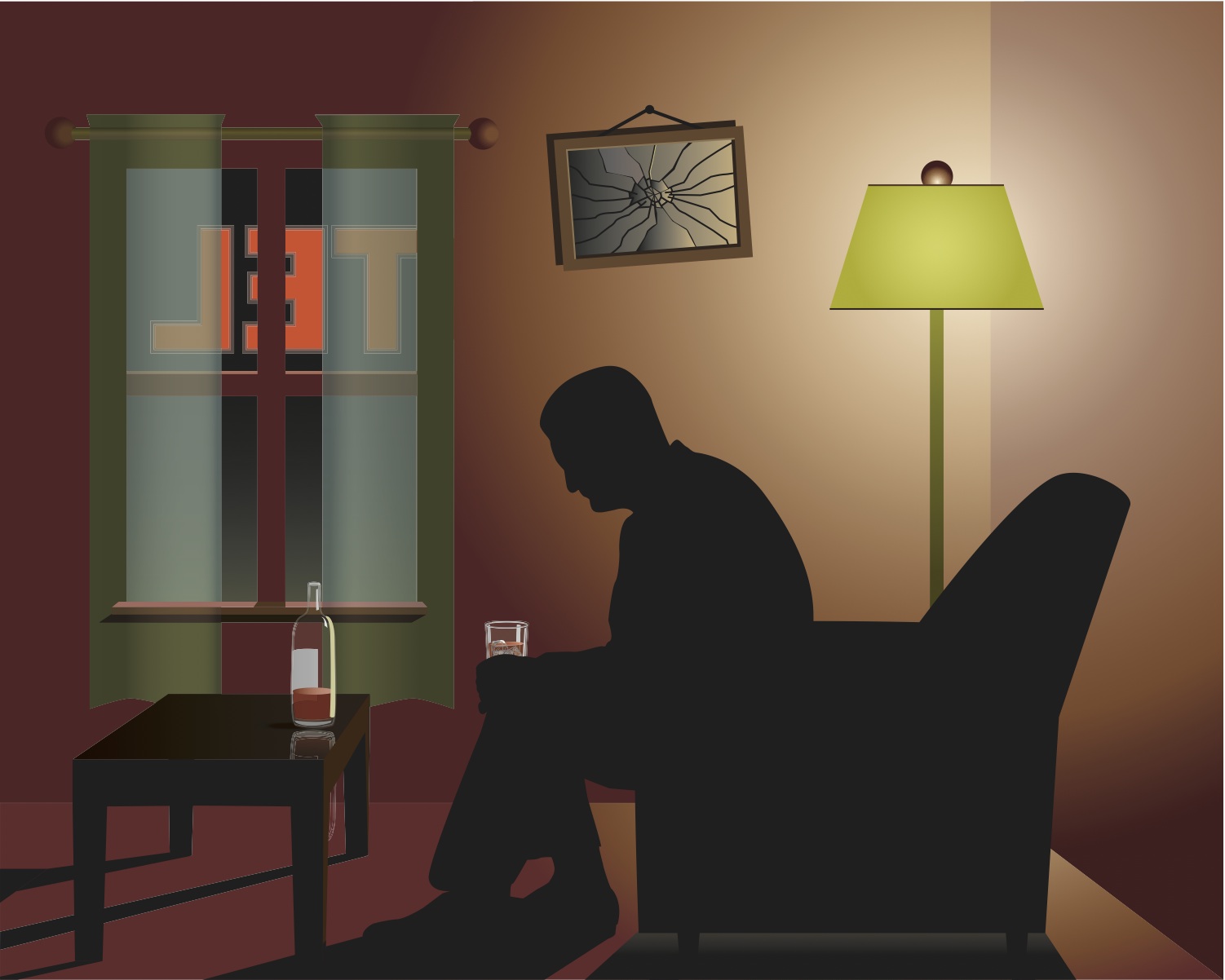

Alcohol use disorder is frequently comorbid with major depressive disorder, and the disease burden associated with this dual diagnosis is considerably greater than that attributed to each disorder in isolation. This creates a problem for clinicians who are trying to treat depressed problem drinkers, because many services are set up to deal with only one of these disorders.
Furthermore, comorbidity may not be immediately apparent. For example, a client may present to treatment services with depression, but further investigation will reveal an undiagnosed alcohol use disorder.
Cognitive behavior therapy (CBT) and motivational interviewing (MI) are psychological therapies that are effective for both disorders. Until recently, the effectiveness of these treatments for comorbid alcohol use disorders and major depressive disorder had not been studied. However, some controlled trials have emerged in recent years. For example, one study evaluated a treatment intervention made up of components of the CBT course ‘Coping with Depression’, together with cognitive-behavioural alcohol coping skills training.
In the present paper, Riper et al. (2014) conducted a meta-analysis of this and other similar trials that investigated this issue.
Methods
This is a meta-analysis of controlled trials that investigated the effectiveness of CBT and / or MI for comorbid alcohol use disorders and depression. In order to be included in the meta-analysis, studies had to include outcome measures related to both alcohol consumption and depression. The CBT / MI had to be compared with either treatment as usual, or an alternative psychological therapy.
The original search identified 9 randomised controlled trials (RCTs), but the authors found an additional 3 studies by relaxing the requirement for trials to be randomised. Non-randomized controlled studies were only included if treatment allocation was not influenced by individual patients, therapists or researchers.
This left them with 12 studies, two of which permitted more than one comparison to be made. For example, one study included computerised and conventional ‘face to face’ CBT, both of which were compared with each other and with a control condition. From these 12 studies, a total of 15 comparisons were included in the meta-analysis. All studies were fairly recent; aside from one study published in 1997, all studies were published between 2006 and 2013.
The analysis considered data from 1,721 participants in total, which meant that the overall meta-analysis was powered to detect a small effect size, allowing for moderate heterogeneity between studies.
Ten of the 15 studies applied CBT / MI that was designed to treat alcohol use disorders and depression together, four were CBT trials targeted only at depression, and one study applied CBT for alcohol problems only.
Most of the studies compared CBT / MI to treatment as usual which was usually psychological counselling and / or medication. This is a real strength of this study: we know from previous trials of CBT that comparison with no treatment tends to yield very large effect sizes, whereas comparison with alternative forms of psychological therapy often yields small effect sizes that are frequently not statistically significant. For example, in the substance misuse field, CBT often comes out as no better but no worse than alternative psychological therapies.
Authors computed effect sizes for both alcohol use and depression, as well as the Number Needed to Treat (NNT).

Results
- Compared to alternative forms of psychological therapy, CBT / MI led to small but significant reductions in symptoms of depression (g = 0.27, 95% CI = 0.13 to 0.41, p < .001; NNT = 6.58)
- CBT / MI also produced small but statistically significant effects on alcohol consumption in comparison to alternative forms of psychological therapy (g = 0.17, 95% CI = 0.07 to 0.28, p < .001, NNT = 10.42)
- Both analyses were highly powered and between-study variance was small. For both outcomes, it made no difference when the analysis was repeated using only one comparison per study, which reduced the total number of comparisons to 12
- Subgroup analyses revealed that digital CBT / MI was more effective than face-to-face treatment for symptoms of depression
- The number of sessions was negatively associated with the effect size for alcohol consumption, i.e. more sessions were less effective than fewer (β = −0.016, p < .01), but this relationship not seen for depression
- Meta-regression revealed that a higher effect size for alcohol consumption was associated with a higher effect size for depression (β = 0.511, 95% CI = −0.04 to 0.99, P = 0.003). Importantly, the reverse relationship was not significant. This means that the effect of treatment on alcohol consumption predicted reductions in depression, but reductions in depression did not predict reductions in alcohol consumption
- Seven studies (8 comparisons) included a follow-up at 6-12 months after end of treatment. The effect size for depression was similar to that seen at the end of treatment (g = 0.26, 95%, CI = −0.01 to 0.54, and the difference only approached significance (p = 0.063)
- For alcohol consumption at follow-up (8 studies and 9 comparisons), the effect of CBT / MI was actually much bigger compared to the effect immediately after the end of treatment (g = 0.31, 95% CI = 0.16 to 0.47, p < .001)
- There was no publication bias for depression outcomes, but a small publication bias for alcohol outcomes (adjustment for) which reduced the effect size from g = 0.17 to g = 0.14

Discussion
Compared to other psychological therapies, CBT and / or MI for comorbid alcohol use disorder and major depressive disorder produced small but robust beneficial effects on both depression and alcohol consumption. The effect size for alcohol consumption tended to increase between the end of treatment and follow-up, which may reflect a ‘sleeper effect’ as participants continued to practice the coping skills needed to resist alcohol consumption even after the end of treatment.
A previous meta-analysis (Nunes & Levin, 2004) revealed that antidepressants could also be effective for the treatment of comorbid substance use disorders and depression. That analysis suggested that effect sizes for depression and alcohol outcomes were larger after antidepressants compared to those reported here (NNTs for depression were 4.72 vs. 6.58 in the present study, and for alcohol use they were 7.14 vs. 10.42 in the present study).
Findings from the two meta-analyses are informative regarding the psychological processes that underlie comorbidity and the mechanism of action of different types of treatment. In this paper, meta-regression revealed that the effect of treatment on alcohol consumption predicted reductions in depression. In other words, if clients can reduce their drinking, their mood may start to improve. By contrast, the Nunes & Levin (2004) meta-analysis of antidepressant effectiveness revealed that improvements in negative mood as a result of medication were associated with improved substance use outcomes. In other words, clients who receive antidepressants should experience an improvement in mood and if they do, they may start to drink less alcohol soon afterwards.
While it is tempting to speculate that antidepressants and psychological interventions may work through different mechanisms, there really isn’t enough data to say this with any confidence. In addition to conducting more trials, Riper et al suggest that future meta-analyses could use patient-level data to investigate the temporal sequence of changes in mood and alcohol consumption during and after therapy.
Limitations
The studies included in the meta-analysis tested outpatients only, so it remains to be seen if CBT / MI would be equally effective for inpatients, who would probably have more severe depression and drinking problems.
Clinical implications
Treatment of comorbid alcohol use disorder and major depressive disorder with CBT / MI seems to produce beneficial effects on both outcomes.
Clinicians don’t need to identify a ‘primary’ diagnosis and treat that in the hope that the other will resolve; both can be treated at once.

Links
Riper H, Andersson G, Hunter SB, de Wit J, Berking M, and Cuijpers P. (2014) Treatment of comorbid alcohol use disorders and depression with cognitive-behavioural therapy and motivational interviewing: a meta-analysis. Addiction, 109, 394-406.
Nunes EV, and Levin FR. (2004) Treatment of depression in patients with alcohol or other drug dependence: a meta-analysis. JAMA, 291, 1887-1896.





ChristiansenLiv
12 years agoSSLP1
12 years agoBreaking_Free_
12 years agoukidcp
12 years agotash_c135
12 years agoThe Mental Elf
12 years agoTracy Spencer
12 years agoLydia Watson
12 years agoBethan Davies
12 years agoLeona Allan
12 years agoClaire McFarlane
12 years agoVivien Kemp
12 years agoElaine Kelly
12 years agoJulia V. Hill
12 years agoMindWise
12 years agoThe Physical Brain
12 years agoRichardCR56
12 years agothinkdrinkdrugs
12 years agoDLapthorne
12 years ago121Therapy
12 years ago121Therapy
12 years agomhequalities
12 years agoTravisHillLPC
12 years agoPsychologystuff
12 years agoAPEAL_Lab
12 years agoShirley747
12 years agoNWPPN
12 years ago2greenglasses
12 years agoGetMindfuel
12 years agoSpecial_Agent26
12 years agodawn_craig
12 years agomerseywonder
12 years agoRachelLP13
12 years agoBCUNursing
12 years agocroc1001
12 years agosuzypuss
12 years agoDannyAgnello_GH
12 years agoNickyjparis
12 years ago121Therapy
12 years agomaggsy2000
12 years agoanniecoops
12 years ago