

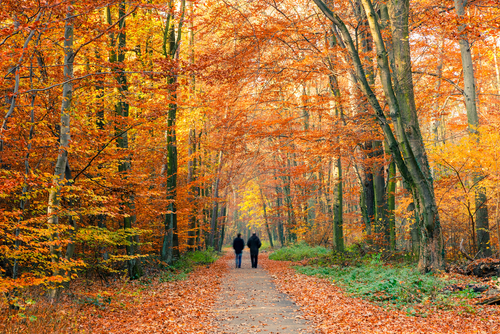

Fancy a stroll through the winter woodland wonderland? If you do, you’ll probably spot an elf or two down in the woods, taking a well earned break from critically appraising research papers. But could these woodland walks actually be improving our mental, emotional, and social wellbeing? “Of course!” I hear you cry, “how could they not be?” Well that’s a good point, but providing robust research evidence to back this up can be tricky.
Marselle et al have tried to do that very thing. Their study draws information from a larger observational, longitudinal study about the mental, emotional, and social well-being from participation in the national Walks for Health (WfH) programme and was published in a special edition of the ‘Ecopsychology and public health’ journal in September 2014.
Previous evaluations of national group walk programs have appeared in the ‘‘gray literature’’ i.e. not published in peer-reviewed journals, and tended to lack a comparison group. Marselle et al have tried to overcome both of these things.
Hypotheses 1, 2 and 3
Their hypotheses for this paper were:
- Individuals who take part in nature-based group walks would experience significantly less (a) depression, (b) perceived stress, and (c) negative affect, compared to individuals who do not take part in such walks;
- Individuals who take part in nature-based group walks would experience significantly greater (a) positive affect, (b) mental well-being, and (c) social well being, compared to individuals who do not take part in such walks;
- The positive well-being from such walks would be independent of other covariates of well-being, such as physical activity and stressful life events.

Methods
This is where it gets a little tricky. Marselle et al used information from the larger longitudinal study investigating the mental, emotional and social wellbeing of individuals who did (Nature Group Walkers) and did not (Non-Group Walkers) attend group walks in nature. In effect creating a study group and a control group.
The selection process however created groups with significant differences in age, gender, ethnicity, education, disability, past physical activity and past stressful life events. The groups were therefore statistically matched using propensity score matching. This is as complicated as it sounds. The propensity score is in effect a way to ‘balance out’ the variables in each group: so each group with the same propensity score will have similar variables allowing comparison. It is used in observational studies to try and mimic the randomization of RCTs (interested in learning more; follow this link Propensity score matching).
Further statistical analysis was then done (t tests and multiple regressions) to look at the influence of nature-based group walks on depression, perceived stress, negative affect, positive affect, mental well-being and social support.
All participants were recruited from a sampling frame, (provided by WfH) of all individuals who had attended at least one WfH group walk, provided an e-mail address, and gave consent to be contacted for evaluation purposes. Online Questionnaires were used to collect data at Time 1 (T1) and 13 weeks later at Time 2 (T2). Non-Group Walkers were defined as individuals who had not taken part in any group walk in the 6 months prior to T1.
The online questionnaires used were:
- Depression: the 10-item Major Depressive Inventory
- Perceived stress: the 10-item Perceived Stress Scale
- Negative and positive affect: the Positive and Negative Affect Schedule
- Mental well-being: participants rated statements on the 14-item Warwick Edinburgh Mental Well-being Scale
- Social well-being: assessed using the 10-item Appraisal subscale of the Interpersonal Support Evaluation List

Results
Valid responses = 1,516: 1,081 Nature Group Walkers and 435 Non-Group Walkers.
In short; group walks in nature were associated with significantly:
- lower depression, perceived stress and negative affect
- greater mental well-being and positive affect
There were no group differences on social support.
In addition, nature-based group walks appear to mitigate the effects of stressful life events on perceived stress and negative affect while synergising with physical activity to improve positive affect and mental well being. Implying that hypothesis 1 and 2 are correct.
Controlling for the effects of health condition, recent stressful life events, frequency and duration of other nature walks, and recent physical activity did not alter the results. Implying hypothesis 3 is correct.

Discussion
There is a wealth of data on the benefits of physical activity for psychological well-being and so some of the results may not be that surprising. I do however have to raise some concerns with regards to the data quality that is being used in relation to the other aspects. Are very short self report questionnaires particularly robust in assessing/diagnosing depression, stress and changes in affect? There appears to be a large quantity of statistical calculations to get to a conclusion – a personal red flag for me that maybe the data isn’t as clear cut as initially thought. The participants were mostly female, older, White, and affluent; while likely to be unrepresentative of the adult general population living in England, participants were representative of the population involved in WfH.
The research overall however provides support for national outdoor group walk programs as a public health intervention. Such programs have previously been shown to increase levels of physical activity, and the study suggests that the benefits go beyond those from physical activity only – a worthwhile outcome to further explore.
Conclusion
The present study found that group walks in nature were associated with significantly less depression, perceived stress, and negative affect and greater positive affect and mental well-being. Given the increase in mental ill health and physical inactivity in the population in the developed world, group walk programs in local natural environments may make a potentially important contribution to both public health and individual well-being with benefits in mental health, coping with stress and improved emotions.
With depression projected to be the number one cause of global burden of disease by 2030 (World Federation for Mental Health, 2012), the results suggest that:
…nature-based group walks could be used to help manage depressive feelings in individuals and in the general population…
Only 6.2% of Nature Group Walkers were referred to WfH by their GP; thus there may be scope for outreach to GPs and other health professionals about the benefits of group walks in nature.

Future exploration of the effects of nature-based group walks on mental and emotional well-being could utilise quasi-experimental pre-post or randomized research designs that would have better inferential potential and reduce limitations of sampling and reverse causality. Further research is needed to discern whether nature group walks moderate, or buffer, the relationship between stressful life events and multiple aspects of well-being.
Future studies could also usefully investigate if there is an optimum frequency and duration of contact with green space, whether alone or in groups, for mental and emotional wellbeing – not necessarily as much as 500 miles though.
Link
Marselle MR, Irvine KN, Warber SL. Examining Group Walks in Nature and Multiple Aspects of Well-Being: A Large-Scale Study. Ecopsychology, September 2014 DOI: 10.1089/eco.2014.0027





Nature-based therapy for stress-related illnesses
8 years agoJustbeingStella
11 years agoYUSU_Welfare
11 years agocprjournal
11 years agoHelenmuk
11 years agohillsideheather
11 years agoFageMD
11 years agoTravisHillLPC
11 years agoasiLLopez
11 years agoharpangel52
11 years agoSW_Reflections
11 years agonuttytart39
11 years agoseach_the_teach
11 years agoMental_Elf
11 years agorizenow
11 years agoLiaisonLawson
11 years agoCASEeducation
11 years agoLucyDPlymUni
11 years agoCASEeducation
11 years agoacaringmind
11 years agoPetronellaPD
11 years agowi_john
11 years agoEJones_MedLaw
11 years agopatmmc2
11 years ago121Therapy
11 years agoSharonMallonPhD
11 years agoMental_Elf
11 years agoYSJActive
11 years agome_martine
11 years agoe32williams
11 years agoDrIanDawe
11 years agoRYW_Birmingham
11 years agotauppen
11 years agoAndy Conway
11 years agoBronwenRetreat
11 years agoTheRetreatYork
11 years agoTheTukeCentre
11 years agoSad_cuckoo
11 years agoSandhurstJogger
11 years agoNatRap84
11 years agonicolavinceward
11 years agoStuart03238046
11 years agoYourVoiceSheff
11 years agoPsych2com
11 years agoRosaAvino
11 years agoSarah Morgan
11 years agoQueasy_Owl
11 years agoIain_caldwell
11 years agoichangemymove
11 years agopaul42smg
11 years agoemjohnston1
11 years agoSarahHarwood9
11 years agoSarahHarwood9
11 years agoJackCoy4
11 years agopgreenfingers
11 years agoOutoftweet123
11 years agobeccimorris13
11 years agopmartinauthor
11 years agoCatalyseC
11 years agobarnes_johnson
11 years agoOsbornInteriors
11 years agoLesley Ann Matthews
11 years agoJune Dunnett
11 years agoJess_Hill1
11 years agoGlister_Online
11 years agoItsHannahsDay
11 years agoeskbankbooks
11 years agorichardpantlin
11 years agoangela_sheard
11 years agobdogrunner
11 years agoangela_sheard
11 years agoHealthMinute1
11 years agoCburgPsych
11 years agoMPowerSocialMed
11 years agoMHABooneCo
11 years agomirandarwolpert
11 years agoedanaming
11 years agohelenlp
11 years agoChristina Armstrong-Graham
11 years agoPHRCLeeds
11 years agotherecycla
11 years agoMental_Elf
11 years ago121Therapy
11 years agodrabagnall
11 years agoDrIanDawe
11 years agoClodaghNee
11 years agoPeteQYork
11 years agowietsetol
11 years agoPrrawa
11 years agokateljeffrey
11 years agoPatramonster
11 years agoDrShirleyLock
11 years agodoesnotexist
11 years agoPrivate_Therapy
11 years agoLorraine Elvis Friguglietti
11 years agoBen Kinsey-Jones
11 years agoSanika Summer
11 years agogavin_atkins
11 years agoMental_Elf
11 years agoBABCP
11 years agoCommunityAsset
11 years agoMental_Elf
11 years agoBritPsyCouncil
11 years agoMistySea164
11 years agotonibeepbeepri1
11 years agoThe Mental Elf
11 years agocoombes119
11 years agojtweeterson
11 years agoAnnaSayburn
11 years agoUKCP_Updates
11 years agoAppa_doodle
11 years agoLiaisonLawson
11 years agokatekarban
11 years agoChiCustard
11 years agoIntipton
11 years agoSocialCareElf
11 years agoMental_Elf
11 years agolypftlib
11 years agoPPSurvivorMum
11 years agorealianbrown
11 years agoPaula Gardiner
11 years agoMental_Elf
11 years agoDrSpriggy
11 years agoAnxietyTracker
11 years agoMental_Elf
11 years agoHookwaySonja
11 years agoCarlotta_raby
11 years agoSarah McKinlay
11 years agoHerne_TheHunter
11 years agoLiaisonLawson
11 years agoLiaisonLawson
11 years agoStAlbansTeam
11 years agoian_hamilton_
11 years ago