

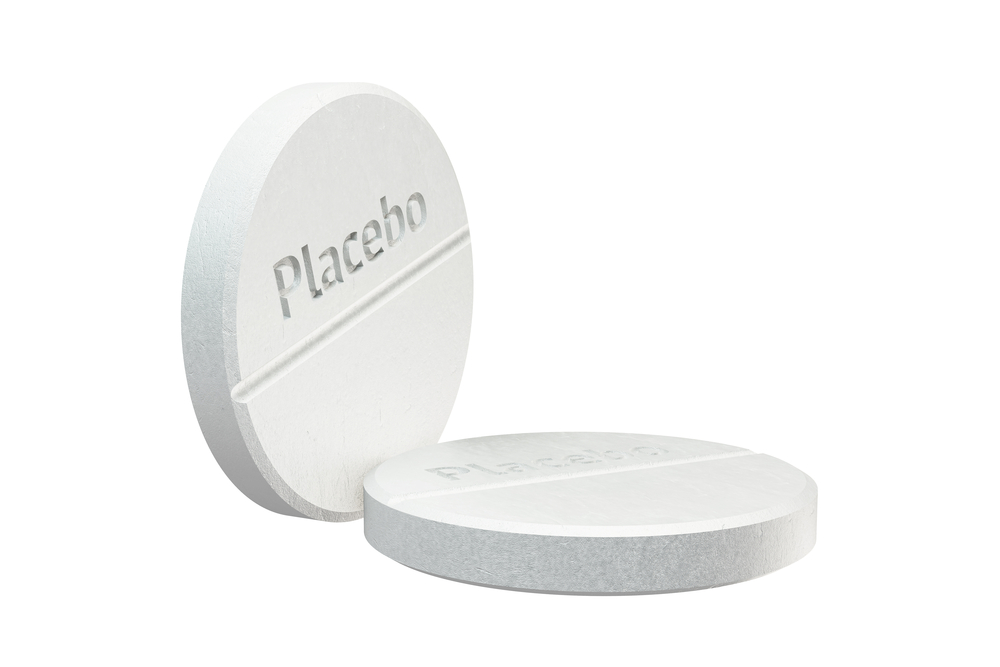

The placebo effect or response represents a phenomenon whereby a fake treatment (usually a relatively inactive substance such as saline or sugar) can mimic the action of a real, active treatment and lead to an improvement in a person’s symptoms because they are expecting the fake treatment to be effective. Placebo is also a band, although irritatingly, they don’t solely perform covers of songs by The Cure.
As you can imagine, the placebo response is important in clinical trials (you want to make sure any treatment is active and not the result of a placebo response) and in the clinical practice of medicine (it would be nice to get a placebo response on top of the active response to treatment you are delivering).
While the mechanisms behind the placebo response are reasonably poorly understood, over the past 20 years, the number of publications devoted to the placebo effect itself has steadily increased. Approximately 10% of all these publications were related to psychiatric classifications, mainly depression.
These papers have primarily been concerned with what influences the effect size of the placebo response in clinical trials and in clinical practice. That is to say, what are the mediators and moderators of the placebo response?
- Mediators (factors which play a role in determining the relationship between something that changes and a thing that changes because of the thing that changed)
- Moderators (factors which determine the strength of the relationship between two things that can change)
Weimer, Colloca and Enck sought to understand this issue further by reviewing a number of placebo-controlled trials within psychiatry. You can attempt to judge if they were successful by reading the resulting article and comparing your understanding with someone who has read an article with the same number of words placed in a random order. If you like.

Methods
31 meta-analyses and systematic reviews of more than 500 randomised placebo-controlled trials across psychiatry were reviewed for factors identified to be associated with an increased placebo response.
Based on this review, factors that might drive the placebo response in randomised controlled trials in psychiatry were grouped into either patient-centred factors that relate to individual characteristics or study design based factors that relate to characteristics of the trial itself.

Results
Patient-Centred Factors
- It could not be concluded that age, sex or ethnicity had any effect on the placebo response in psychiatry trials.
- The most predictive individual factor for a high placebo response is a low symptom severity at baseline. Therefore, the less severe the symptoms of a person’s mental illness are, the more likely they are to experience a placebo response to an inactive treatment purporting to be an active psychiatric treatment. This was the case across studies in schizophrenia, psychosis, children with autism, obsessive-compulsive disorder, attention deficit hyperactivity disorder, binge-eating disorder, and depression. So basically a hefty portion of the DSM-V.
- Another factor reported to be associated with high placebo responses was a short history of illness, although this might also represent the effect of lower symptom severity, i.e. if you haven’t had something very long, the symptoms might not have had a chance to get as severe as they will.

Study design factors
The placebo response appeared to be greater in more recently published studies. For example, in randomised controlled trials of people with depression, the placebo response increased by approximately 7% per decade between 1981 and 2000. This was irrespective of the antidepressant that the placebo was being compared with. However, the trend vanished when the same dataset was examined and patient assessments of treatment outcome were the focus as opposed to efficacy, which may mean that the increase in placebo response in more modern trials is driven by bias on the part of the assessors.
Only one mediator of high placebo responses was consistent across studies and mental illness categories: unbalanced randomisation (any deviation from a 1:1 randomisation allocation). An increased chance of being randomly assigned to the drug group increased the efficacy of both drug and placebo within the studies examined.

Predictors of experimental placebo response
Researchers across all specialties of medicine have attempted to identify the predictors of placebo responses within experimental settings.
- Personality: Overall while the picture is inconsistent due to a lack of study replication, the degree of placebo response appears to be moderated by patient expectations of how their symptoms might change after treatment. Most psychometric tests do not screen for these variables, probably because of the type of people who come up with them.
- Brain networks: The placebo response has not one, but multiple neural mechanisms. Placebos seem to use the same pathway as the respective drug that they are being compared against, mimicking the drug action in a similar but less effective manner. The placebo response has been associated with the dopaminergic reward system, although this is not a list that’s getting shorter.
- Genes: The present database of papers on placebo is currently too small to reliably identify genetic mediators of the placebo response in people categorised as having a mental illness. So once you’ve finished reading this you’d better get out and do some research. You can have a hot beverage first.
Conclusions
The reviewers acknowledge that while the placebo response is present and effective in all disorders, predictors of placebo response are still largely unknown.
Only a limited number of potential moderators have maintained relevance across studies including:
- low symptom severity at baseline,
- a more modern trial design, and
- unbalanced randomisation.

Limitations
It was recognised by the authors that their analysis downplayed potential differences in placebo response in specific disorders to focus instead on mediators and moderators across disorders. Regardless of this, it is likely that different diseases, disorders and treatments are associated with different underlying placebo mechanisms. They also acknowledged that the review was limited to studies of the placebo response in drug and non-drug trials, rather than being able to examine novel trials that were specifically designed to investigate the placebo response in clinical investigations.
All placebo-controlled trials can be considered ethically questionable to some extent as they involve a group of patients receiving a less than optimal therapy, not to mention the level of deception involved in allowing patients to believe that they may be receiving the most effective treatment for their condition. As such, the Declaration of Helsinki permits placebo-controlled trials only when just inadequate routine treatment options are available.
A placebo response is undesirable in clinical research (we want to know that a treatment works in its own right), but may be helpful in clinical practice, adding to the positive effects of active treatments. Identifying moderators and mediators of the placebo response is essential in ensuring the correct degree of the effect is elicited in any given setting. However, this review only examined the placebo response in randomised controlled trials. The placebo response is highly dependent on expectations, which are likely different between trials and in the ‘real world’ of clinical treatment. As such, the result of this review may not be applicable outside of the trial environment.
Summary
Our understanding of the mechanisms that mediate or moderate the placebo response to psychiatric treatments has increased (slightly) over recent years.
This review identifies low symptom severity at the start of treatment as a patient-centred factor that predicts increased placebo response and unbalanced randomisation as a trial-centred response that predicts increased placebo response.
However, the review did not examine studies which looked specifically at the placebo response and may not be applicable to the placebo response in the clinical setting. As is always the case, more research is needed. I’ll put the kettle on.

Links
Primary paper
Weimer K, Colloca L, Enck P. Placebo effects in psychiatry: mediators and moderators. Lancet Psychiatry 2015;2(3):246−257 [PubMed abstract]
Other references
Rutherford BR, Pott E, Tandler JM, et al. Placebo response in antipsychotic clinical trials: A meta-analysis. JAMA Psychiatry 2014;71(12):1409−1421 [PubMed abstract]
Enck P, Bingel U, Schedlowski M, Rief W. The placebo response in medicine: Minimize, maximize or personalize? Nat Rev Drug Discov 2013;12(3):191−204 [PubMed abstract]





Post Of The Week – Saturday 13th June 2015 | DHSB/DHSG Psychology Research Digest
11 years agoBefriendService
11 years agoPBuildingBlocks
11 years agoQualitasRes
11 years agosjoecable
11 years agoLovingSanders
11 years agoCharliHuggett
11 years agopsychiatrist81
11 years agopsychiatrist81
11 years agoAasimKarbhari
11 years agoLexxxVink
11 years agokompulsion
11 years agoRecoveryUnplugd
11 years agoSameiHuda
11 years agoJeremyHowick
11 years agoJeremyHowick
11 years agoiFredorg
11 years agoHHLibService
11 years agoHughFMcQ
11 years agoBorisSchmalz
11 years agoTheLancetPsych
11 years agoMikemod1S
11 years agodr_ashutosh82
11 years agoSusan Armstrong
11 years agoErica Richmond
11 years agoLynn Staffylover
11 years agoroosstals
11 years agojohnthejack
11 years agoTomJBailey7
11 years agoaghoury79
11 years agohullodave
11 years agoandretylee
11 years agodmctools
11 years agoTamsin_J_Ford
11 years agoMental_Elf
11 years agobrianleetham
11 years agoNeuroKneel
11 years agoMental_Elf
11 years agoHeadstedUK
11 years agohullodave
11 years agoSameiHuda
11 years agoajj_1988
11 years agororymb
11 years agoMiranda_dWD
11 years agomollycrossman
11 years agoMental_Elf
11 years agohullodave
11 years agoDrAhmadAlShayea
11 years agoMental_Elf
11 years agoCaroline Davis
11 years agotimdalmau
11 years agoMentalWealth123
11 years agoDrKenCarter
11 years agoNeilOConnell
11 years agoKatie Simpson
11 years agoArt Therapy Study
11 years agoEamonn Duffy
11 years agoNHFTNHSLibrary
11 years agoMental_Elf
11 years ago_imaginatrix
11 years agomental_truths
11 years agowi_john
11 years agoAdibEssali
11 years agoNeedMoreCourage
11 years agomel_lean
11 years agoNeedMoreCourage
11 years agoMental_Elf
11 years agohullodave
11 years agosjblakemore
11 years agoMental_Elf
11 years agoYtakSnikpoh
11 years agoMichelle Colledge
11 years agoMRMCILRAVEY
11 years agoAndrew Philip Holden
11 years agoiVivekMisra
11 years agotlail_lanni
11 years agoTrishLane13
11 years agoBigTonyWalker
11 years agoian_hamilton_
11 years agoaghoury79
11 years ago