

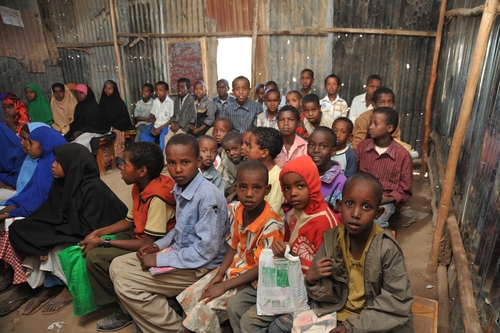
![Refugees face a substantially higher risk of psychotic disorders compared to non-refugee migrants [see previous blog].](https://www.nationalelfservice.net/content/uploads/2016/03/6862450441_e83a504169_b.jpg)

It is estimated that at the end of 2012 there were 10.5 million refugees worldwide. About half of these were under 18 years old (UNHCR, 2013).
It’s consistently found that rates of PTSD and other mental health problems are high amongst refugees (Bogic et al, 2012). The trauma and disruption involved is especially problematic for children because it effects things like schooling and social development that has a disproportionate impact later on (Viner and Ozer, 2012). Unsurprisingly access to mental health services for refugee and asylum seeking children is poor (Reed et al, 2012, Folkes, 2002).
Despite a clear need for mental health services amongst refugee and asylum seeking children, there’s little known about which models and strategies are most effective. Tyrer and Fazel at the University of Oxford set out to review relevant interventions that had been evaluated in schools, community and in refugee camps.
Methods
A comprehensive search of electronic databases and contact with experts combined with strict inclusion criteria allowed them to whittle down 21 studies from 1,716. These 21 studies included a total of about 1,800 children.
The quality assessment using the Yates scale showed some variation: 4 fulfilled the quality criteria, 10 partially so and 7 didn’t fulfil it. For example, only 6 of the studies had data on rates of retention, and minimising of biases was only reported in 18 of the studies. The quality of the interventions varied as well: fulfilled (7 studies); partially fulfilled (8); not fulfilled (6).
The authors are frank about this variation in quality and it also makes clear why a meta analysis wasn’t possible. In many ways, the landscape of publications reflects the diversity of the population and contexts being considered.

Results
The variation amongst the studies is a finding in itself. Here’s a more detailed breakdown:
- Two broad classes of interventions:
- 9 based on verbal processing of past experiences (e.g. CBT, EMDR)
- 7 based on creative art techniques (e.g. music, drawing, drama)
- Also, 5 studies used a combination of both.
- Study designs included:
- 8 with random allocation to groups
- 8 cohort designs
- 4 controlled clinical trials
- 1 case control trial.
- Interventions were delivered in:
- Schools (11 studies)
- Refugee camps (7)
- Community (3)
- Refugee camp schools (2)
- Four of these involved consulting professionals in other services to better cater for mental health problems.
- Numbers of study participants ranged from 6 to 315.
- Recruitment strategies differed across studies. For example, in 5 studies whole classes received the intervention whereas in another 6 studies, children were selected based on meeting specific criteria.
- Most interventions lasted 10-12 weeks with a range of 2 to 16 weeks. The number of individual sessions varied between 6 and 17 with most lasting one hour.
Having found that there’s a mix of studies out there, what about the actual effectiveness of these studies?
- Both verbal processing and creative-art based therapies led to significant reductions in symptoms of depression, anxiety, PTSD, functional impairment and peer problems.
- All but one of the studies set in camps showed significant findings. This means that therapy is effective even when children are in temporary settlements.
- Both group and individual therapies were effective as were short and long-term interventions. This suggests there’s flexibility and opportunities for cost-effective ways of delivering interventions.
- There are some contradictions when looking across studies. For example one study found interpersonal psychotherapy (IPT) effective over activity-based interventions on depression and that the latter was no more effective than waiting list controls. However, another study found creative-art techniques significantly reduced depression. This means one study suggests only verbal-processing based therapies are effective whilst another found that activity based therapies are actually worth pursuing.
Seven of the studies reported enough data for the authors to calculate effect sizes using Cohen’s d. This showed:
- Effect sizes ranging from 0.31 to 0.93 (Cohen said 0.2 is small, 0.5 is moderate, 0.8 is large). Six of the seven studies had effect sizes in the moderate to large range.
- The moderate to large effects related to changes in symptoms like: depression; anxiety; PTSD; functional impairments, peer problems, resource hardship and well-being.
- Five of the seven studies involved were based on those using verbal processing of past experiences (like CBT and EMDR).
Although the authors tried to make comparisons across the studies using Cohen’s effect size, the result doesn’t convince me of the superiority of one type of treatment over another. The variation in studies also makes it hard to compare interventions against each other. To find out more about the problem of comparing psychotherapies, try reading Sammy Man’s blog from January 2014.

Conclusions
In study abstract reports that:
Only a small number of studies fulfilled inclusion criteria and the majority of these were in the school setting. The findings suggest that interventions delivered within the school setting can be successful in helping children overcome difficulties associated with forced migration.
Summary
I felt that the authors made pretty fair conclusions about their findings. As we can see, there’s only 21 relevant but wildly different studies. This is all we’ve got to draw conclusions about what will be effective for millions of wildly different children. I think the review is a decent descriptive account of the mix of studies currently published, but sadly it doesn’t allow us to reliably draw conclusions about what works and what doesn’t.
I like to think I work with a diverse range of people, but really all these people are supported by a homogenous and fairly stable political system (even one that’s a tad unfair…). It’s therefore easy for me to take comfort in the validity of NICE guidelines for those I work with. However, in a context as diverse, dynamic and unpredictable as political unrest and epidemics, perhaps interventions become meaningless when taken away from the individual context in which they were devised.
Links
Tyrer, R., & Fazel, M. (2014). School and Community-Based Interventions for Refugee and Asylum Seeking Children: A Systematic Review. PLoS ONE 9(5): e97977.
UNHCR. (2013) Global trends 2012. Geneva: UNHCR.
Bogic M, Ajdukovic D, Bremner S, Franciskovic T, Galeazzi MG, et al. (2012). Factors associated with mental disorders in long-settled war refugees: refugees from the former Yugoslavia in Germany, Italy and the UK. British Journal of Psychiatry 200: 216–223.
Viner RM, Ozer EM, Denny S, Marmot M, Resnick M, et al. (2012). Adolescence and the social determinants of health. Lancet 379: 1641–1652.
Reed RV, Fazel M, Jones L, Panter-Brick C, Stein A. (2012) Mental health of displaced and refugee children resettled in low-income and middle-income countries: risk and protective factors. Lancet 379: 250–265.
Folkes CE. (2002). Thought field therapy and trauma recovery. International Journal Emergency Mental Health 4 (22): 99–103.
Man, S. (2014). “Everyone’s a winner, all must have prizes!” but which psychotherapy for depression wins, if any? The Mental Elf, 30 Jan 2014.





Matthew Fish
11 years agoGEOGRAPHICGAP
11 years agoHUMSOCIALGOOD
11 years agoHUMHEALTH
11 years agobarbm172
11 years agotg_greg
11 years agocaputpurgijs
11 years agoLaurenceDCP
11 years agoLaurenceDCP
11 years agoLaurenceDCP
11 years agoLaurenceDCP
11 years agoLouisecombes
11 years agoELatchem
11 years agoNHFTNHSLibrary
11 years agoIain_caldwell
11 years agominafazeloxford
11 years agoOutofSightDoc
11 years agoSameiHuda
11 years agoCarlotta_raby
11 years agoCarlotta_raby
11 years agoOldsoldier8585
11 years agoOldsoldier8585
11 years agoYoungMindsCEO
11 years agodavelaaad
11 years agoOTBeth131
11 years agoMental_Elf
11 years agopsychwatch2
11 years agopatmmc2
11 years agocoombes119
11 years agoplaytherapy_BA
11 years agokaymagpie
11 years agoHollyKBurke
11 years agoCCareStandards
11 years agolypftlib
11 years agoPeteQYork
11 years agoMental_Elf
11 years agoChristina Armstrong-Graham
11 years agoLucy Riddett
11 years agoWill Convery
11 years agoin2mh
11 years agoCYPSNEP
11 years agoCHFTLibrary
11 years agocairnstony9
11 years agoMental_Elf
11 years agoserenderen
11 years agoLucyDPlymUni
11 years agoShamaila89
11 years agomhresources
11 years agocozzameena
11 years agochristoclifford
11 years agoangela_sheard
11 years agoThe Mental Elf
11 years agocozzameena
11 years agotherecycla
11 years agoMental_Elf
11 years agoMental_Elf
11 years agoPsychthinks
11 years agoMasumaRahim
11 years agostrategiesuws
11 years agoKehksha Azam
11 years agoSusanne Hart
11 years agoHartlepoolMind
11 years agoIain_caldwell
11 years agoaghoury79
11 years ago