



In recent times, few drugs have caused more excitement among clinical researchers than ketamine. It’s well known for its role in anaesthesia and veterinary surgery (“horse tranquilizer”), as well as its illicit use, but progress has been ongoing for about 15 years to repurpose it as an antidepressant.
As a consequence, many new studies are published every month that evaluate to what extent ketamine lives up to its promise as a new antidepressant drug (Aan Het Rot, Zarate, Charney, & Mathew, 2012). To make sense of the flood of new information, naturally intrigued mental elves clearly need researchers to provide timely updates of the current state of knowledge. To this end, Coyle and Laws (2015) have recently published an extensive systematic review and the first meta-analysis that summarises the latest, methodologically sound research.
The key questions of interest to these researchers were:
- Does ketamine have an immediate effect in reducing depressive symptoms?
- Are the antidepressant effects of ketamine sustained over time?
- Are repeat infusions more effective in reducing depressive symptoms?
- Do primary diagnosis and experimental design moderate the impact of ketamine on depressive symptoms?
- Do men and women experience differences in the antidepressant effect of ketamine?

Methods
The authors followed PRISMA guidelines and scanned all relevant medical databases for studies assessing the antidepressant potential of ketamine in patients with major depressive disorder (MDD) and bipolar disorder (BD). To evaluate possible methodological factors and design variables, the authors also specifically assessed whether studies were: repeat/single infusion, diagnosis, open-label/participant-blind infusion, pre-post/placebo-controlled design and patients’ sex.
Effect sizes were calculated either relative to placebo or relative to baseline, in case no control group was provided. To correct for bias in small studies, a Hedge’s g procedure with random effects was used. Statistical heterogeneity, publication bias and moderator variables were assessed to have an idea of other variables that might influence the reported antidepressant potential of ketamine. Statistical heterogeneity among studies was assessed using I² values, with values above 50% generally representing substantial heterogeneity.
Results
In total, 21 studies enrolling 437 patients receiving ketamine were identified that satisfied inclusion criteria:
- 17 were single infusion studies and the majority reported data collected at 4h (11) and 24h (13) after ketamine treatment
- 6 studies had follow-up for 7 days
- 4 studies had follow-up for 12-14 days
In general, there are grounds to assume publication bias for single infusion studies at 4h and 24h.
Of the 21 included studies, 2 were judged to be at a high risk of bias, 13 medium risk and 6 low risk of bias.
- In general, ketamine had a large statistical effect on depressive symptoms that was comparable across all time points
- Effect sizes were significantly larger for repeat than single infusion at 4 h, 24 h and 7 days
- For single infusion studies, effect sizes were large and significant at 4 h, 24 h and 7 days
- The overall pooled effect sizes for single and repeated ketamine infusions found no difference at any time point, suggesting that the antidepressant effects of ketamine are maintained for at least 12-14 days
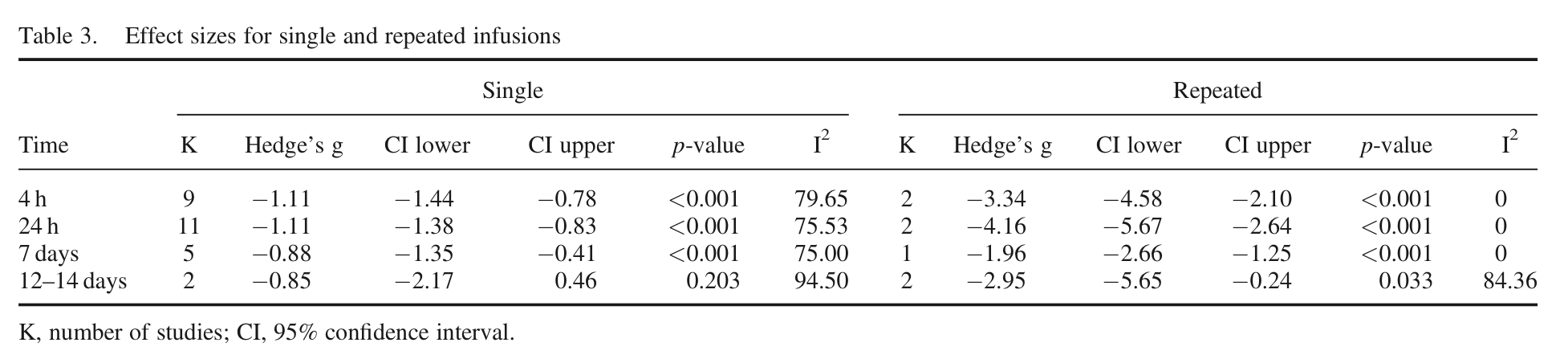
Moderator analyses suggest that responsiveness to ketamine may vary according to diagnosis. Specifically, while ketamine produced moderate to large effects in both MDD and BD patients, the effect of a single infusion was significantly larger in MDD than BD after 24h. On the other hand, after 7 days, this pattern reversed and ketamine showed higher efficacy in BD patients. However, the small number of studies makes it tricky to draw any conclusions.
In addition, single-infusion pre-post comparisons did not differ in effect size estimation from placebo-controlled designs except for at 12-14 days, where only one study was available. In a similar vein, there were no effect size differences between single infusion studies with open-label and blinded infusions.
Of note, the meta-analysis found the percentage of males in the group was positively associated with ketamine’s antidepressant effects after 7 days, although this finding warrants replication with more data points.

Conclusions
The authors conclude:
Single ketamine infusions elicit a significant anti-depressant effect from 4h to 7days; the small number of studies at 12-14 days post infusion failed to reach significance. Results suggest a discrepancy in peak response time depending upon primary diagnosis – 24 h for MDD and 7 days for BD. The majority of published studies have used pre-post comparison; further placebo-controlled studies would help to clarify the effect of ketamine over time.
Limitations
This meta-analysis suffers from several limitations that are inherent in the available studies:
- For one, there were only four studies that assessed the effect of repeated ketamine infusions, which is a shame given that maintenance of antidepressant effects is one of the key drawbacks of rapidly acting interventions
- In addition, the authors note that their results suggest publication bias, which may be taken to indicate that several negative findings have not been published and thus could not be included in this meta-analysis
- Also, more information about adverse effects would have been useful, especially to evaluate whether ketamine can be safely applied in a broader clinical context
Summary
This is the first meta-analysis to evaluate ketamine’s antidepressant effects. For single infusion specifically, ketamine exerts large antidepressant effects in MDD as well as BD patients that seem to last at least 7 days, while too few studies are available beyond this time point.
It’s noteworthy that the effect sizes did not differ between time points, which indicates that the effect of a single infusion remains relatively stable in the short-term. While repeated infusions were shown to provide higher effects than single infusions at least for the first week, more studies are needed to corroborate the supremacy of repeated treatment.
Before ketamine can become a clinically viable treatment option, however, this review makes it clear that more methodologically refined studies (especially RCTs with adequate placebo controls) need to be conducted. With this in mind, researchers should take these findings as an incitement to action!

Links
Primary paper
and (2015), The use of ketamine as an antidepressant: a systematic review and meta-analysis. Hum. Psychopharmacol Clin Exp, doi: 10.1002/hup.2475. [PubMed abstract]
Other references
Aan Het Rot, M., Zarate, C. a, Charney, D. S., & Mathew, S. J. (2012). Ketamine for depression: where do we go from here? Biological Psychiatry, 72(7), 537–47. doi:10.1016/j.biopsych.2012.05.003



Forskning på ketamins antidepressive effekt (Mental Elf) « PsykNytt
11 years ago3rd Links, emails and news 06/05/15 | Kent Community Learning Disability Team
11 years agoGary
11 years agoPost Of The Week – Sunday 12th April 2015 | DHSB/DHSG Psychology Research Digest
11 years agoPaulPOCTwit
11 years agoSHIPUSOCIALWORK
11 years agoloopylourugman
11 years agoJayDuckworth
11 years agoMartingaughan
11 years agoslashelf
11 years agojoble_jabel
11 years agocinziacaporale
11 years agoserenderen
11 years agoMental_Elf
11 years agocsmony
11 years agodrabagnall
11 years agosteitelman
11 years agoDarren Francis Oakes
11 years agoHorshamPsychol
11 years agoUWSHeatherN
11 years agoFageMD
11 years agoSomaPsy_Nant
11 years agostuartdmethley
11 years agoCarlotta_raby
11 years agoIain_caldwell
11 years agoJohnathanLaird
11 years agoaghoury79
11 years agoSameiHuda
11 years agoDebJudge1
11 years agoDebJudge1
11 years agomark_bolstridge
11 years agoian_hamilton_
11 years agoweeal36
11 years agoMental_Elf
11 years agoScott Inglis
11 years agoMichael Dalili
11 years agoNabuccoDream
11 years agoTravisHillLPC
11 years agoNabuccoDream
11 years agoTheLancetPsych
11 years agoNabuccoDream
11 years agoNabuccoDream
11 years agoBroadbentAmy
11 years agoAndy Conway
11 years agoDenise Evangelista
11 years agoMosaic Training Consultancy Ltd
11 years agofabngroovy
11 years agoLiz Young
11 years agoNeuroKneel
11 years agoL_Dirk
11 years agoRaluca Lucacel
11 years agoCaroline Davis
11 years agoHelen House
11 years agotombssimon
11 years agobaldranger
11 years agoLilyPiccal
11 years agoEBalkowiecIskra
11 years agoAilsaDeniseCave
11 years ago1c75a
11 years agostefpbrug
11 years agopavelsrnicek
11 years agomaelorin
11 years agotheOfficeRabbit
11 years agoiVivekMisra
11 years agoBenMacCam
11 years agoegosyntonically
11 years agoDrFranMeeten
11 years agoDrShirleyLock
11 years ago_SMHR_
11 years agoaghoury79
11 years ago