



For me, one of the most infuriating aspects of health care is the relegation of mental health problems, and mental health services, as secondary to physical health.
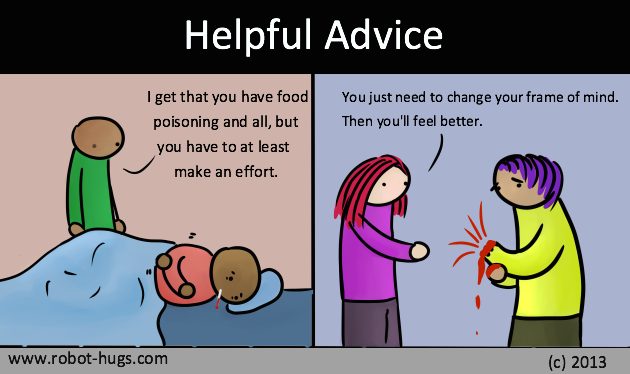
There are a myriad of examples of this, from the classic stigma that people with mental health problems receive compared to those with physical health problems (fantastically illustrated by the Robot Hugs comic), to the way in which deficiencies in physical care make front page news while mental health services wither in relative obscurity (have you seen any national headlines about staffing problems on mental health wards? Yeah, me neither…).
The lack of physical health treatment for people with serious mental illness is a particularly ugly twist on this. We know for example that people with long-term physical health problems can have their depression ignored or minimised (Coventry et al. 2011), in line with the problems above where mental health is considered secondary or somehow less important.
In people with severe mental illness (SMI), the opposite seems to occur: their physical health needs and problems seem to be ignored because only the management of their mental health problem is considered (see (De Hert, CORRELL, et al. 2011) for a quite devastating review of all the different physical health problems which are more common, or less effectively treated, in patients with SMI).
This is called ‘diagnostic overshadowing’, where negative stereotypes or assumptions about symptoms lead to physical health being less thoroughly treated or recognised (Thornicroft 2011). I almost wish I could say that’s because in this case the mental illness is the priority, but it’s really another example of neglect. In this case, the narrow focus on managing only the mental health problem means ignoring the person who has that problem, and their wider needs. Perhaps worse than the scenario where services ignore the mental health problem, in this case it seems they only manage the mental health problem, and ignore the person instead.
The cost of this to that person has been quantified: people with SMI die on average up to 20 years earlier than the rest of the population, and the cause of death is predominantly untreated physical illnesses. While some of this is attributable to medication side effects and lifestyle factors (not that those can be dismissed – the severe physical costs of some medications and the fact that people with SMI tend to have more vulnerable lifestyles are serious problems in themselves), there are also clear disparities in access to care and health professional screening of problems (De Hert, Cohen, et al. 2011).

To try to address this, there have been various calls for better screening of problems in patients with SMI and attempts to improve management and monitoring of physical health in this group. One approach is to encourage GPs/family doctors to give more physical advice to patients with SMI, and that’s what this recent Cochrane review aimed to explore (Tosh et al, 2014).
Methods
- The review covered all randomised clinical trials focusing on general physical health advice for people with serious mental illness
- They included 7 studies comprising 1,113 patients in total. Six of these compared provision of advice to standard care. They weren’t able to properly compare different types of advice giving as these analyses were “grossly underpowered”. (You know statisticians are cross when they roll out the word ‘grossly’)
- They evaluated the quality of the included studies
Results
On the whole, results were unimpressive. Two studies indicated that provision of advice led to greater uptake of health prevention services and more contact with primary care, but overall the studies were of low quality and results equivocal. Consequently, with the state of current evidence being as it is, it isn’t possible to determine whether there are benefits of general physical health advice, or actually whether there may be risks of clinicians spending time and effort on something that is ineffective.

Conclusions
Attempts to synthesise the evidence were limited by poor design and poor reporting. The authors note that it was unclear in most studies if randomisation was done properly, and that three of the studies were sponsored by pharmaceutical companies, which raises concerns about the independence of the findings. They were, quite rightly, again A Bit Cross:
Much data were often reported in such a way as to make comparative analyses impossible and we were unable to report data for many outcomes.
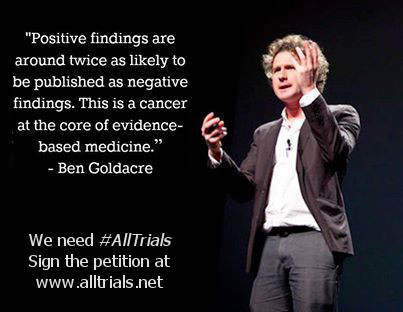
I applaud the authors for their plea (on page 30 of the review) for researchers to sign up to the AllTrials campaign to encourage better reporting and greater transparency. The campaign calls for all trials to report all methods and results, so that we can actually make use of the data produced, which is given to us, remember, by patients themselves who have agreed to take part. Those patients deserve better. The patients paying up to 20 years of life deserve better too.
NB. There’s a very good plain language summary for the review. Possibly the reason it’s so good is that it’s been written by a member of the audience so to speak (Ben Gray from Rethink) rather than by the research team, a practice I would heartily encourage other reviewers to follow.
Links
Tosh G, Clifton AV, Xia J, White MM. General physical health advice for people with serious mental illness. Cochrane Database of Systematic Reviews 2014, Issue 3. Art. No.: CD008567. DOI: 10.1002/14651858.CD008567.pub3.
Coventry, P.A. et al., 2011. Talking about depression: a qualitative study of barriers to managing depression in people with long term conditions in primary care. BMC Family Practice 2011, 12:10 doi:10.1186/1471-2296-12-10
De Hert, M., CORRELL, C.U., et al., 2011. Physical illness in patients with severe mental disorders. I. Prevalence, impact of medications and disparities in health care. World Psychiatry, 10(1), pp.52–77.
De Hert, M., Cohen, D., et al., 2011. Physical illness in patients with severe mental disorders. II. Barriers to care, monitoring and treatment guidelines, plus recommendations at the system and individual level. World psychiatry: official journal of the World Psychiatric Association (WPA), 10(2), pp.138–151.
Thornicroft, G., 2011. Physical health disparities and mental illness: the scandal of premature mortality. The British Journal of Psychiatry, 199(6), pp.441–442.





Psych med-induced weight gain: what role can dieticians play? | Sectioned
11 years agoStellaWYChan
11 years agoSysReviews
11 years agoIsha2501
11 years agoamydlibrarian
11 years agoucl_crucitwit
11 years agoBABCP
11 years agodnunan79
11 years agoTheoldbank45
11 years agoDrIanDawe
11 years agoMental_Elf
11 years agoPaula Gardiner
11 years agoThe Mental Elf
11 years agoGill King
11 years agoVivien Kemp
11 years agoHampshire Healthcare Library Service
11 years agoJames Thompson
12 years agoM_Spence_
12 years agodr_know
12 years agoEyeSpyFan
12 years agoThorvid_HoliCow
12 years agosourcecodeman
12 years agoGDelusa
12 years agoBwoodHighland
12 years agoscharrlib
12 years agoNHFTNHSLibrary
12 years agoBondySWFC
12 years agoYSJmultisports
12 years ago121Therapy
12 years agochristoclifford
12 years agoCtCzippy
12 years agoAudreyClark3
12 years ago121Therapy
12 years agoSexEdUKation
12 years agoukstewg1
12 years agoGill King
12 years agoVivien Kemp
12 years agoHampshire Healthcare Library Service
12 years agoJane Bernal
12 years agoBACP
12 years agojtrevmhn
12 years agolypftlib
12 years agoHaVeN_Dundee
12 years ago121Therapy
12 years agoBPSOfficial
12 years agoMental_Elf
12 years agomrgchalky
12 years agoSJaneBernal
12 years agoPeter_Tennant
12 years agoalleydog_dotcom
12 years agoasangafern
12 years agoexistentialacad
12 years agoAliyahReh
12 years agotrickyt_12750
12 years agoLiaisonLawson
12 years agoLizHughesDD
12 years agofairydesouza
12 years agoEyeSpyFan
12 years agoPaula Gardiner
12 years agoThe Mental Elf
12 years agoSnuggles84
12 years agoSectioned_
12 years agoMental_Elf
12 years agoanniecoops
12 years agosi3144
12 years agoJoeJudgePsy
12 years agoaghoury79
12 years agoIain_caldwell
12 years agoAddictionNotDis
12 years agosamirshah
12 years ago