

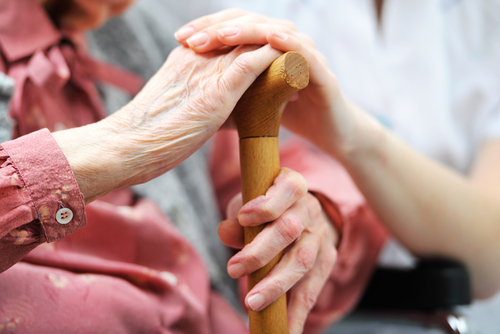

Caring for someone with dementia can be stressful, but also very rewarding (Sutcliffe et al., 2015). The more the condition advances, the more reliant are people with dementia on their family members in everyday activities, such as managing medication or preparing a hot meal but also in other day-to-day decisions around care and support (Giebel et al., 2015).
This means that carers are not only emotionally attached to their partner, parent, family member or close friend, but may also experience stress and tiredness that can be associated with intensively caring for a loved one with dementia. So when the person with dementia is temporarily or no longer under the full-time care of the carer, this can be quite stressful because of several reasons, as the research examined in this blog explores.
One example where carers have to give up their full-time caring role temporarily is when their relative with dementia is hospitalised. This can be concerning in itself due to the physical problems their relative is experiencing as a cause for being hospitalised.
In this blog, I am looking at a recent qualitative study by Bloomer and colleagues (2014) from Monash University in Australia, who have explored the various experiences of family carers of people with dementia who are hospitalised.
Method
The authors conducted a qualitative study through in-depth interviews with family carers of people living with dementia. They report that the sample ‘included spouses, adult children and friends of the persons with dementia, ranging in age from 34 to 92 years, with the majority in the 70s and 80s. There was an even gender distribution’.
The interviews were held in a 60-bed specialist hospital facility for older people in Melbourne, Australia.
Using a conversational approach during interviews of up to 45 minutes (with the average duration being 25 minutes), the research team interviewed English-speaking adult carers.
All interviews were transcribed and were subject to thematic analysis. Every member of the research team listened to and read the interviews several times, to make sure they picked up every important detail, and subsequently analysed the data.
Findings
In total, 20 family carers were interviewed. Most carers were spouses, and thus many were co-residing with the person with dementia. It is interesting to note that carers said that the study in itself was ‘a relief’, as it offered them the opportunity to discuss and share their experiences. Overall, four main themes emerged from the thematic analysis:
Feeling helpless and lost
Carers stated that they felt ‘lost’ after their relative’s hospitalisation, because they temporarily had to give up their caring role, which in many cases was a full-time job.
Losing control and feeling undervalued
Carers reported feelings of a loss of control. This is related to the first theme, in that carers lost being able to contribute to decisions about the type of care received in the hospital, and so felt undervalued as their expertise in the care for their relative was not drawn upon.

Family support and conflict
Carers reported both positive and negative experiences in relation to their family support. Some noted that their children were supportive and made the decision about admitting their relative to a care home after hospitalisation easier. However, some carers had negative experiences and lacked family support.
Opportunities for improvement
Many carers believed that the hospitalisation of their relative needed no improvements. However, some people expressed concerns that healthcare professionals should consider the expertise and needs of the carers.
Conclusion
The authors concluded that:
Family caregivers have few opportunities to talk freely about their feelings about the patient’s care and how the hospitalisation affects them personally. It is important that they are well supported and given the opportunity to talk about their issues in a safe space.

Strengths and limitations
There are few limitations to this study, none of which were mentioned by the authors:
One possible shortfall is that only English-speaking carers were interviewed. Understandably, there are language barriers in qualitative research (also in quantitative obviously!), but we often do not capture a more complete picture of dementia and carers by making efforts to include people from black and ethnic minorities whose first language may not be English.
There may be specific cultural issues that effect the way carers from different ethnic minorities feel about the hospitalisation process, which would give us a richer picture of the research theme ‘opportunities for improvement’. But maybe this is one for future research!?
Summary
Overall, I thought this was a really insightful study about one of the two important people in the dementia situation – the carer. People often forget about the people surrounding the person with a condition, but without the carers, most people living with dementia would not be able to live independently in their own homes for as long as many do.
Along with the person living with dementia, carers have insights and expertise into individual strengths and preferences that should be seen as an asset for hospital and health as well as social care.
Links
Primary paper
Bloomer, M., Digby, R., Tan, H., Crawford, K., & Williams, A. (2014). The experience of family carers of people with dementia who are hospitalised. Dementia, doi: 10.1177/1471301214558308 [Abstract]
Other references
Giebel, C.M., Sutcliffe, C., & Challis, D. (2015). Activities of daily living and quality of life across different stages of dementia: a UK study. Aging & Mental Health, 19 (1), pp.63-71. [Abstract]
Sutcliffe, C.L., Giebel, C.M., Jolley, D., & Challis, D. (2015). Experience of burden in carers of people with dementia at the margins of long-term care. International Journal of Geriatric Psychiatry, doi:10.1002/gps.4295 [Abstract]





MODEMproject
11 years agojacksc12
11 years agoianscott73
11 years agoAdmiralDeb
11 years agoMental_Elf
11 years agoCWTFood
11 years agoEasyReadDave
11 years agoOTBeth131
11 years agoSocialCareElf
11 years agoThe Social Care Elf
11 years agoClarissaGiebel
11 years agoClarissaGiebel
11 years agoLynRomeo_CSW
11 years agoBPSOfficial
11 years agoSocialCareElf
11 years agoeve_potts
11 years agoSWilson
11 years agoRobinHadley1
11 years agoMICRA_Ageing
11 years agoPSSRUManchester
11 years agoHHLibService
11 years agoPaully232000
11 years agoPaully232000
11 years agobcpft_research
11 years agoDementiaJournal
11 years agoRynTin85
11 years agoClarissaGiebel
11 years agoDementiaJournal
11 years agoAspirantdiva
11 years agobeatdementia
11 years agoCECLibrary
11 years agosmallwoodlib
11 years agoIOWNHSLibrary
11 years agoClarissaGiebel
11 years agoannatatton1
11 years agoClarissaGiebel
11 years agoClarissaGiebel
11 years agoIntipton
11 years agoSCIE_sco
11 years agoJeanneCarlin
11 years agoIain_caldwell
11 years agoDrivenbyhealth1
11 years agoerferrum
11 years agoAENEUROPSI
11 years agopeterjsimcock
11 years agoDesKellyOBE
11 years agodragonmisery
11 years agoAspirantdiva
11 years agoMental_Elf
11 years agoFamilyCareTrust
11 years agoClarissaGiebel
11 years agoMODEMproject
11 years agoripaljeet
11 years agoAdelinaCoHe
11 years agooutcomeimps
11 years ago