


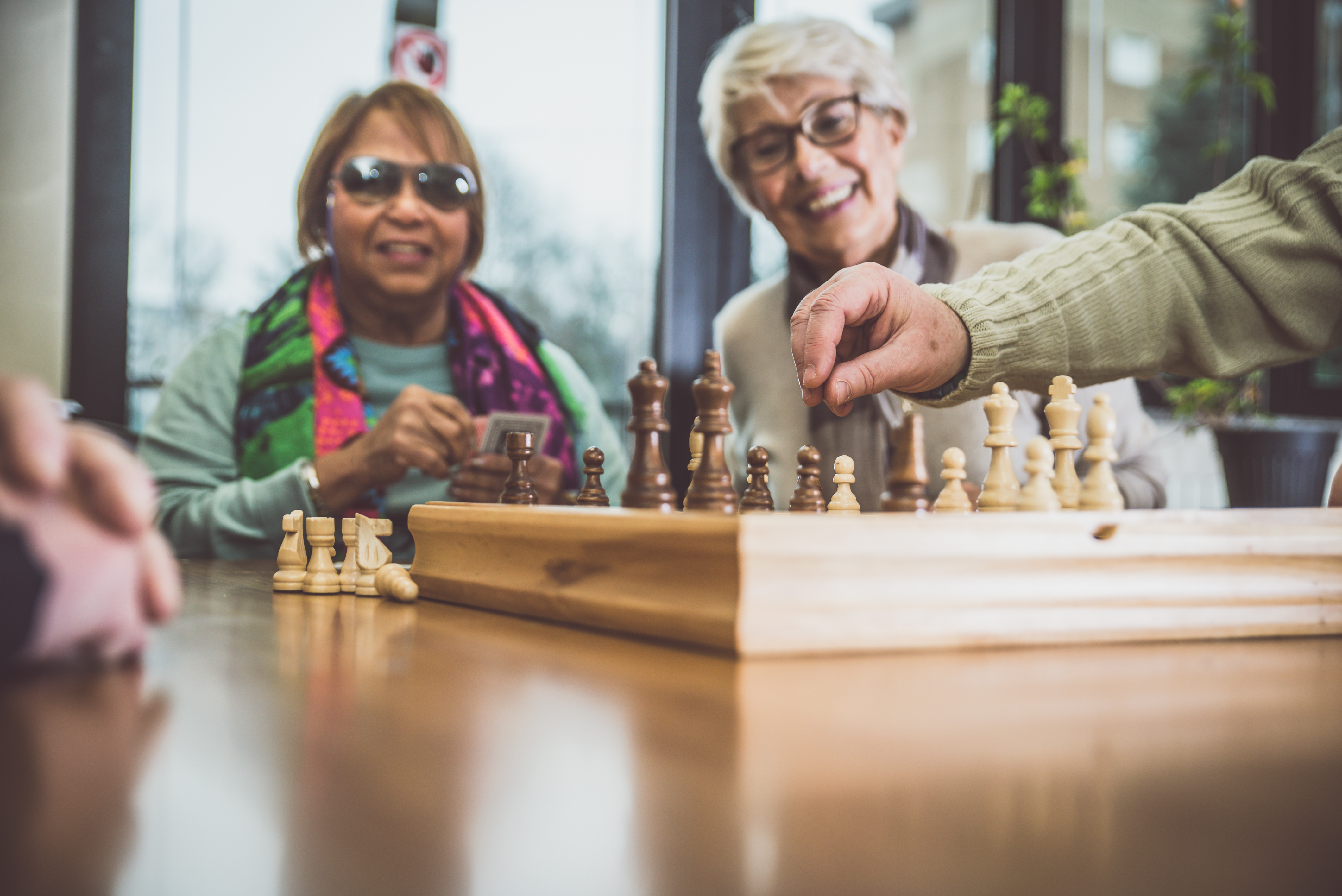
Sitting, apparently doing nothing, in the lounge of care home may be many people’s image of residential care. This article reports an important study that tested a programme of activity for care home residents who were stroke survivors.
Surely, such investment in helping care home residents would make a positive difference to residents’ lives? But in the pressured context of many UK care homes, would any researchers manage to get them to participate? And what sort of activity could be tried in care homes that could be measured and evaluated?
This study evaluated whether there was robust clinical and economic evidence to show that using a treatment (here meaning not just medical treatment) model which has been successful in others settings and has shown promise in this setting could be of benefit to care home residents.

Method
The programme or model tested was a three month course of individualised occupational therapy (OT).
In this programme the residents set their own patient-centred goals (with the OTs), the care home staff were educated about the activities, and physical adaptations relevant to the residents’ stroke-related disabilities were made in the participating care homes.
By way of example, such an OT intervention could help a resident learn to dress the top half of their body more independently by assessing what difficulties were facing the resident and helping care home staff to give the resident more time, minimal assistance but prompts, and more encouragement.
Alternatively another resident could be helped to stand up from a chair by a member of staff helping them to practise the movements, checking the chair’s height, prompting and providing some assistance with placing the resident’s feet in the correct position.
Naturally, in a big and complex trial a lot of things were measured – before and after the intervention and then later to see if the effects lasted, changed, or declined.
Findings
This study produced several important findings.
First, while it is well known that care home residents who have had a stroke are a very disabled group –this study found that many were more disabled than anticipated.
Second, it was a study that was able to recruit a large number of care homes (228) in different parts of the UK, enlisting 1042 residents. This is a major achievement and sets a ‘gold standard’ for research trials in care homes.
Third, it was possible to do a randomised controlled trial (RCT) – half the homes (114) got the intervention (the activities programme and half (another 114) did not. This type of RCT is called a cluster RCT – and is highly suitable for social care and similar provision where it is hard to do different things with different residents/users in the same setting.
And lastly, the really important finding, after three months of the OT services and 12 months of observations for any effects, was that there was no evidence of benefit on residents’ abilities, mobility, mood or health related quality of life. This is meaningful as the study recruited such large numbers from so many different homes.
How do the researchers interpret their findings that there was no real evidence of benefit? They suggest that such was the high level of disability of many the stroke-affected care home residents (and they excluded residents receiving end of life care) that the ideas of patient-centred goal setting and activities need to be revisited to see if they are really relevant to care home residents.
One further interesting finding was their conclusion that the amount of ‘adaptive equipment’ in the care homes before they did the study was low compared to that available to people living in their own homes after a stroke, and highly variable. They recommend that this inequality be addressed – this could be taken up locally by Healthwatch or advocacy groups.

Conclusion
The research team does not conclude that OT should not be offered to individual care home residents who have survived strokes. They suggest that this may well be of benefit to residents with lower levels of disability on an individual basis.
They conclude that other approaches should be developed in support of care home residents.
Strengths and limitations
As noted above this was a big trial and the conclusions are clear. There were many ways in which the outcomes were measured. This makes it an important study – it is not surprising that it was reported in a leading journal, the British Medical Journal.
Summing up
Such is the current interest in dementia that care home residents who have survived a stroke may not receive much attention by comparison (although they are sometimes the same people). Perhaps this explains the poor state of affairs in which the residents and the care home staff were not supported by the right equipment.
The overall findings that the OT activity programme did not have the effects that might be presumed present a challenge for health and social care researchers to find ways that provide good support that promotes residents’ quality of life and a good culture of care in the home. It is also a very good example of how ‘promising’ ideas need to be more than just promising before put into practice – as they may not turn out to be so good after all.

Link
Sackley, C. M., et al. (2015) An occupational therapy intervention for residents with stroke related disabilities in UK care homes (OTCH): cluster randomised controlled trial. BMJ 2015; 350:h246 [Full Text]




Support needs of stroke patients and carers: survey from a drop-in service
9 years agoLorraine Bridges
10 years agosuperspesh
10 years agoewegaxypop
10 years agovypucybyc
10 years agoynimewin
10 years agocatiqata
10 years agoaawalker
10 years agoSocialCareElf
10 years agoSocialCareElf
10 years agoUEAResearch
10 years agoUEA_Health
10 years agorelaswar
10 years agoscottishcare
10 years agoVeronicaMonks
10 years agoJonesDavidN
10 years agoscwru
10 years agoscwru
10 years agoguy_per
10 years agoDrCBernard
10 years agoAspirantdiva
10 years agoPowysTHBLibrary
10 years agojaffaparks
10 years agobrenclifford01
10 years agoSocialCareElf
10 years agoscwru
10 years agoJonesDavidN
10 years agoscwru
10 years agoOTBeth131
10 years agohelenfindlay
10 years agoSocialCareElf
10 years agoAMLTaylor66
10 years agoSocialCareElf
10 years agoHHLibService
10 years agoShonaH1961
10 years agoshowmetheaccess
10 years agoDrivenbyhealth1
10 years agodr_shibley
10 years agoSocialCareElf
10 years agoSocialCareElf
10 years agoTheStrokeElf
10 years agoMichael Clark
10 years agoIntipton
10 years agoIOWNHSLibrary
10 years agoIntipton
10 years agogmason1963
10 years agomargaretOT360
10 years agoSCIE_sco
10 years ago