


Historically, eating disorders have been discussed in a very black and white fashion; either you do or you don’t have one. Whilst this may be beneficial in terms of research and diagnosis, it isn’t particularly helpful for those that sit in the grey area between the two. People in this grey area are often referred to as having disordered eating, or a sub-threshold eating disorder and often find their symptoms as severe as those with a full eating disorder diagnosis.
The prevalence of disordered eating has been estimated to be around 6% and research has shown that individuals with disordered eating are more likely to have other psychiatric disorders, such as low mood or anxiety (McBride et al, 2013). However research has focused mainly on White European, or North American ethnicity, with less focus on Hispanic and Asian Groups, and has largely ignored men.
This issue seems quite topical at the moment with a recent Huffington Post news article discussing the stereotype that young Asian girls don’t suffer from eating disorders. The article raises the issue that although Eating Disorders Awareness Week has just been and gone we should continue to raise the awareness and understanding of eating disorders in less studied groups, such as men and ethnic minorities.
Solmi and colleagues have tackled this issue in their recent research which looks at the prevalence and correlates of disordered eating in the general population across gender, body mass index (BMI) and ethnicity, in addition to looking at patterns of service use.

Methods
This was a questionnaire study using The South East London Community Health (SELCoH) general population survey data in the London boroughs of Lambeth and Southwark. Computer-based questionnaire interviews were distributed to qualified participants, and all data was collected between June 2008 and December 2010.
Measures
- Disordered Eating: measured with the SCOFF questionnaire (screening tool for EDs)
- Psychiatric Morbidity: Revised Clinical Interview Schedule (CIS-R) assesses depressive and anxious tendencies
- A three level variable was created ‘no diagnosis’, ‘non-specified neurotic disorders’, and ‘mood, anxiety and mixed mood and anxiety disorders’
- Personality Disorder: The Standardised Assessment of Personality-Abbreviated Scale (SAPAS) was used to screen for the presence of personality disorders
- Post-Traumatic Stress Disorder (PTSD): the Primary Care PTSD scale (PC-PTSD) was used to screen for PTSD
- Suicidal Ideation and/or attempt: two questions asked about suicidal ideation and attempts, and were collapsed into one variable
- Alcohol Use: Alcohol Use Disorders Identification Test (AUDIT) was used to asses drinking, creating 3 variables
- healthy drinking, hazardous drinking, and hazardous and harmful
- Any Drug Use: Participants were categorised into those who had, and hadn’t used drugs at least once in the past year
- Smoking: Three level categorical variable of ‘never smoked’, ex-smoker’, and ‘current smoker’
- Help Seeking: Participants were asked whether they had sought help from a GP or therapist for problems with anxiety or depression in the last year. Those who said yes were then asked follow-up questions relating to this experience
- Socio-Demographic Questions:
- BMI: was split into four groups:
- Underweight (BMI<18.5)
- Normal weight (18.5 ≤ BMI < 25)
- Overweight (25 ≤ BMI < 30)
- Obese (BMI ≥ 30)
- Age: was measured continuously and then divided into six groups (16-24; 25-34; 35-44; 45-54; 55-64; 65+)
- Ethnicity: divided into four categories:
- White (White British)
- Black (Black African, and Black Caribbean)
- Asian (Indian, Pakistani, Bangladeshi, or Chinese ethnicity)
- Any other ethnic background (those who did not identify themselves with any of the categories above)
- Education: Three level variable (no qualifications), (completed GCSEs and/or A-Levels), and (higher degree or above)
- Marital Status: Single, Married, or Co-Habiting
- BMI: was split into four groups:

Results
All analysis was run on individuals with complete outcome and exposure data, which meant a total of 1,644 participants (age range = 16-90, mean age = 39.6).
- Prevalence of Disordered Eating
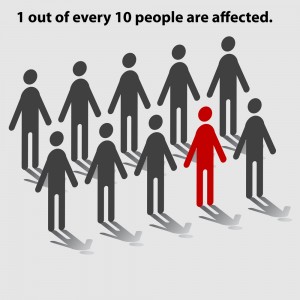
- 10% (164 participants) reported disordered eating
- What are the Socio-Demographic Correlates?
- Disordered Eating was reported:
- Significantly more for woman (12.2%) than men (5.9%)
- More participants from the youngest (16-24) age group (16.1%)
- More commonly reported by Asian (14.8%) and mixed or other ethnicity (16.1%) followed by Black Caribbean and African (12.8%) and then White (7.9%)
- More participants in the obese BMI group (13.9%)
- Disordered Eating was reported:
- What is the Association between Disordered Eating and Behavioural and Psychological Outcomes?
- Associated with having greater psychiatric comorbidity; using drugs; hazardous and harmful alcohol use; increased odds of PTSD and PD diagnosis; anxiety; mood
- What is the Relationship between Disordered Eating and Service Use?
- 36% of those with disordered eating had sought help for anxiety or depression in the year prior to the study
- Most saw a GP (27.4%), therapist (12.8%), or mental health specialist (5.5%)
- 31.7% respondents said they did not seek help even though they thought that they needed it
- Having disordered eating increases the odds of having seen a GP, mental health therapist, or specialist disorders; sub-threshold neurotic disorders; suicidal ideation/attempts
Overall the main finding was that 10% of participants in this inner-city sample reported disordered eating, which was more common amongst females, younger respondents, those with higher BMIs, and ethnic minorities.
Conclusions
The authors concluded that:
Our findings thus suggest that disordered eating and ED [eating disorder] manifestation in ethnic minorities, usually underplayed, need further investigation in multi-ethnic and inner-city settings, where they are more prevalent

Comments
The authors highlight that the findings of higher co-morbidity between disordered eating, anxiety, PD, PTSD, drug use, and hazardous levels of drinking, but this does not imply causation and further longitudinal studies are needed to research this.
Although the research indicates a link between disordered eating and co-morbidities, such as those outlined above it would be useful to research why this is the case.
Additionally, the measures used for PD, PTSD, and disordered eating were screening questionnaires which do not give sub-scales for different disorder related behaviour. Therefore a detailed analysis of specific associations between disordered eating behaviours and different PDs was not possible.
Furthermore, although there was a significant difference between males and females for disordered eating (specifically related to weight loss) the broad nature of the questions asked could have meant that further, more specific differences were not detected.
In order to increase the power to detect differences within the sample the authors collapsed a number of variables, such as a range of ethnicities into the ‘other ethnic background’. Therefore it was not possible to make conclusions about some ethnic backgrounds, compared to others.
Although 37.6% of the sample was from a non-white ethnic background, the authors note that future studies should aim to recruit bigger samples of ethnic minorities to increase the power, and precision of results.
Finally, as is true of most surveys, the data was self-report and may be subject to bias. It is also difficult to know whether there were people in the sample with Eating Disorder Not Otherwise Specified (EDNOS) which has gone undiagnosed. Some would argue that EDNOS is very different from disordered eating. Out of the total sample 4.4% of participants reported having received an eating disorder diagnosis but it would have been helpful to know what this diagnosis was. Ideally those with an eating disorder diagnosis should have been excluded from analysis if the conclusions of the research are solely about disordered eating. This 4.4% make up nearly half of those that reported disordered eating.
Despite these limitations, the study indicates the need to further consider and research disordered eating across gender and ethnicity. More detailed longitudinal research should investigate co-morbidity and associations between disordered eating and other psychiatric diagnoses. Research should also focus on barriers to service use, particularly in ethnic minorities, who may feel unable to seek help, or don’t have access to the appropriate level of care.
Links
Solmi, F., Hatch, S. L., Hotopf, M., Treasure, J., & Micali, N. (2014). Prevalence and correlates of disordered eating in a general population sample: the South East London Community Health (SELCoH) study. Social psychiatry and psychiatric epidemiology, 1-12.
McBride, O., McManus, S., Thompson, J., Palmer, R. L., & Brugha, T. (2013). Profiling disordered eating patterns and body mass index (BMI) in the English general population. Social psychiatry and psychiatric epidemiology, 48(5), 783-793.
Why Are Young Asian Girls Invisible When It Comes to Eating Disorders? By Akeela Ahmed.
More information on Eating Disorders Awareness Week
You can find more information on Eating Disorders Not Otherwise Specified (EDNOS) from beat.





Nicola Davies
10 years agoMental_Elf
12 years agoMaxineHoward333
12 years agoApexCounselling
12 years agoSickenBelow
12 years agoIain_caldwell
12 years agosadiestrong
12 years agotombssimon
12 years agoNicola Davies
12 years agoMindEdUK
12 years agoCaribdreams
12 years agoanniecox01
12 years agoanniecox01
12 years agoTheSandlings
12 years agoM_SilversteinUK
12 years agoMental_Elf
12 years agodrsanazir
12 years agosrstherapy
12 years agoMindEdUK
12 years agosellis1808
12 years agoJenWildBerry
12 years agoMental_Elf
12 years agoSameiHuda
12 years agoSameiHuda
12 years agoMental_Elf
12 years agoDuckBeaki
12 years agoMaxineHoward333
12 years agobeatED
12 years agoDuckBeaki
12 years agoMental_Elf
12 years agoRoslynByfield
12 years agoRoslynByfield
12 years agocharitybegin1
12 years agoglosswitch
12 years agopash22
12 years agoPastoralHC
12 years agoWBmeded
12 years agoMental_Elf
12 years agoukidcp
12 years agoNessMonster88
12 years agobcqinstitute
12 years agoJanet741
12 years agoBPSOfficial
12 years agoHHLibService
12 years agosandrabtuvesson
12 years agowheeliesmom
12 years agoCreativeAspie
12 years agoSysReviews
12 years agoMental_Elf
12 years agoscienceofeds
12 years agoscienceofeds
12 years agoMaxineHoward333
12 years agoMaxineHoward333
12 years agoMaxineHoward333
12 years agooceanoxford
12 years agoMental_Elf
12 years agocnwlrc
12 years agoMental_Elf
12 years agolypftlib
12 years agoRoslynByfield
12 years agoRoslyn Byfield
12 years agoMental_Elf
12 years agoVSEDS
12 years agoMental_Elf
12 years agoMaxineHoward333
12 years agounafoye
12 years agoMaxineHoward333
12 years agoMaxineHoward333
12 years agoaghoury79
12 years agoThe Mental Elf
12 years agoneurolette
12 years agoLiteracyHealth
12 years agoaghoury79
12 years agoambridgeview
12 years agoSovaSupportLink
12 years agoShrinkMeNow
12 years agoTheTinyBakery
12 years ago