



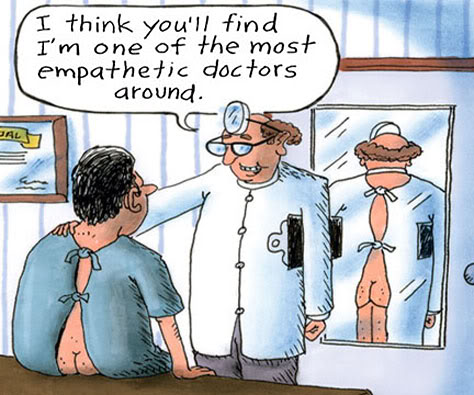
When I started to write this blog I used the age-old tactic from schooldays of having the TV on in the background to “help my concentration”. And then I got distracted by a comedy featuring – you guessed it – a stupendously un-empathic doctor. How weird is that? It’s spooky being an Elf sometimes.
One would always hope for, although sadly not necessarily expect an empathic doctor. To be honest, I’m usually quite grateful if they’re not young enough to be my daughter or son. Whilst medical education in most cultures explicitly emphasises the importance of empathy, there is evidence that this desired characteristic declines during medical education, and is “lower than ideal” in physicians.
Studies indicate that doctors overlook or miss empathic opportunities in patient encounters.
Methods
I have to confess, I rolled my eyes when I first read the title of this review – Interventions to cultivate physician empathy: a systematic review (Kelm et al, 2014). I was being rather unfair as it turned out. It’s definitely a very worthwhile question to ask, and I was actually quite surprised to learn that this was the first review comparing quantitative evaluation studies on the subject.
I was also impressed with the methods the researchers used and the logic and clarity of the reporting. Not only did they have a librarian’s help in designing the literature search strategies (although as usual, they only considered studies written in English), they also explicitly reported their adherence to the PRISMA (Preferred Reporting Items for Systematic Reviews and Meta Analyses) guidelines. As I work for the EQUATOR (Enhancing the QUAlity and Transparency Of health Research) Network, an organisation dedicated to promote the use of reporting guidelines, it was heart-warming to see.
Inclusion criteria were studies where:
- Intervention was designed to cultivate empathy
- Empathy was evaluated using quantitative outcome measures, and statistical analysis
- The population were qualified doctors or medical students

Results
Types of intervention
The interventions designed to cultivate empathy were of several types:
- Communications skills training interventions were used in nearly a third (20) of the studies, and usually consisted of a mixture of lectures, videos, experiential workshop training such as practice interactions using role play and feedback.
- Around a tenth of the studies (seven) primarily used role play with study participants acting as patients. For example one study had medical students injecting each other with saline solution.
- Another tenth of the studies (six) were described as using “humanities”, which included reflective writing from the patient point of view and theatre.
- Three studies used balint training which involves small group discussions focussed on patient emotions.
- Two studies used mindfulness-based stress reduction (MBSR), a type of meditation characterised by non-judgmental, moment-to-moment awareness.
- One study used problem-based learning sessions focussing on empathy and communication.
- Over a third (23) of the studies mixed a variety of interventions so these could not be easily categorized, although they consisted mostly of communication skills training interventions.
Characteristics of included studies
Sixty-four studies met the inclusion criteria and data on ten metrics were extracted from each including:
- Study size and time frame of outcome assessments.
- Whether a control group and random assignment was used.
- The validity of the outcome measures.
- Whether or not a statistically significant increase in empathy was reported.
The statistical significance thing worried me a bit. Unless researchers in each study have specified and justified the minimally useful effect size to a patient-relevant outcome, statistical significance doesn’t necessarily mean that the intervention would make a useful difference in real life.
Quality of the evidence
The researchers also graded the 64 studies into three tiers of methodological quality, and only ten studies made it into the top tier. Of those ten methodologically rigorous studies, eight found that the intervention had a statistically significant positive effect on empathy.
Overall, the percentage of studies reporting a significant positive effect was 66%, although as previously mentioned the studies as a whole were characterised by poor design, inadequate reporting, and the time-frame of follow up was mostly very short or immediate. The studies were mostly small, and vague descriptions of interventions mean they cannot be replicated in further evaluation research, or put into practice.
Patient-reported outcomes
Only six of all the studies (9%) measured patient reports of empathy, despite the existence of reliable and valid patient-report measures. Having read the review quite carefully, all I really wanted to find out was which studies reported a significant increase in empathy using patient-reports, and had a follow-up of more than a few weeks – in other words, any studies which vaguely approached real life. I dug around in the additional tables just in case, and alas there were none.

A final note
As you’ve read this far, I’d recommend you take an extra ten minutes to watch an inspiring video made by the Canadian Patient Safety Institute. It’s a mother’s moving story in her own words which perfectly illustrates how important it is for healthcare providers to take just a little time to try and understand every patient’s perspective. In particular, her courageous intervention on behalf of her daughter taught one doctor what I am sure was an invaluable and lasting lesson in empathy. That is what I call a significant result.
Link
Kelm Z, Womer J, Walter JK, Feudtner C. (2014) Interventions to cultivate physician empathy: a systematic review. BMC Medical Education 2014; 14(1): 219. doi:10.1186/1472-6920-14-219.





Jessica Walker
11 years agoangliacounsel
11 years agomark
11 years agolearnhospice
11 years agofind_therapy
11 years agoS_Amani
11 years agoIain_caldwell
11 years agoProfSarahCowley
11 years agoSusieMaier
11 years agoAmyPricePhD
11 years agoSUREteamCardiff
11 years agopsychwatch2
11 years agopsychwatch2
11 years agoPsySocialGold
11 years agoNHFTNHSLibrary
11 years agopsychthinks
11 years agoChristina Armstrong-Graham
11 years agoshearer_robyn
11 years agoflackp1
11 years agoMental_Elf
11 years agocyberwhispers
11 years agoUWSMichaelF
11 years agoPRISMAStatement
11 years agoNancyMcNeilance
11 years agoniadla
11 years agoPatient_Safety
11 years agoaghoury79
11 years agoEQUATORNetwork
11 years agoSUREteamCardiff
11 years agoSUREteamCardiff
11 years agoMacPFD
11 years agoLindyRexie
11 years agonxtstop1
11 years agoStuckonSW
11 years agoBrooklineCAN
11 years agocreativeartprac
11 years agonxtstop1
11 years agonxtstop1
11 years agoStuckonSW
11 years agoSysReviews
11 years agoLPTresearch
11 years agoamdickinson1
11 years agoMental_Elf
11 years agoThe Mental Elf
11 years agoclivestone22
11 years agobilginhulya
11 years agomishkasaurus
11 years agoMental_Elf
11 years agotroyvista
11 years agoSanazRiahi
11 years agofocus_Warner
11 years agoALOISCommunity
11 years agoCECLibrary
11 years agohermitsholiday
11 years agoMental_Elf
11 years ago121Therapy
11 years ago121Therapy
11 years agoMental_Elf
11 years agoSomaPsy_Nant
11 years agolypftlib
11 years agoCIPS_UoM
11 years agoHibbertMarie
11 years agoOlivia Cialdi
11 years agoaymorrison
11 years agopash22
11 years agoRandall_JAC
11 years ago121Therapy
11 years agoaghoury79
11 years ago