



According to Time to Change, over a third of the public think people with a mental health problem are likely to be violent.
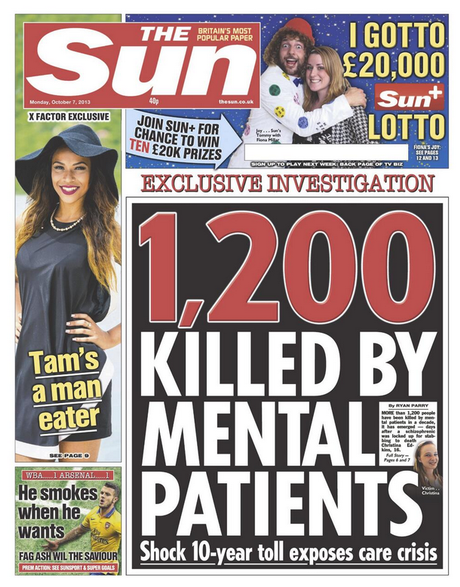
Homicide by people who are also patients with mental illness is perceived as contributing to negative public attitudes towards people with mental illness. Tragic and high profile killings by people with mental illness are often used to suggest that somehow so called “normal” people do not commit violent crime and if you do so, you must have a mental illness of some kind. It is a rare for a news story covering a homicide not to at least mention the mental health of the accused perpetrator.
The quotes throughout this post were from the first five news stories that came up when I searched Google for the word “Schizophrenic”. One is from a reader’s comment on the article. I decided not to use any more of these when even one article’s comments contained enough stigmatising language against people with mental illness to fill three textbooks and a toilet wall.
People with a diagnosis of schizophrenia in particular are often viewed as being violent and dangerous. Stigmatising language towards people with mental illness is often used to describe violent crimes where there is no apparent connection of the crime to the perpetrator’s mental health. If you don’t think so, you’re probably some kind of “psycho nutter”.
A paranoid schizophrenic stabbed his mother to death after convincing himself his parents were part of a satanic paedophile ring.
However, people with a severe mental illness are actually more likely to be victims of violence and crime than people in the general population. Where previous studies have investigated victims of homicide, people with a diagnosed mental illness were shown to have a 3-6 times higher risk, with higher risk still for people with diagnoses of alcohol and drug misuse.
Hit by a schizophrenic motorist who claimed voices in his head told him to drink-drive.
The study I’m summarising in this blog was conducted by the National Confidential Inquiry into Suicide and Homicide by People with Mental Illness (NCI). Their aim was to assess how often victims of homicide were current patients of mental health services.

Methods
Data for the case series were collected over four stages:
- Collection of a national sample of homicide victims for whom conviction of a homicide were recorded
- Acquisition of the victims’ offending history
- Identification of patient victims who had been under the care of the mental health services within a year of their death
- Within the aforementioned group; collection of clinical data
The data for all suspected homicide offences in England and Wales between 1st January 2003 and 31st December 2005 were obtained from the Home Office Statistics Unit via the Homicide Index (comprehensive information about all offenses recorded as homicide).
This study only included confirmed victims of homicide. Information about the victims was sent to the main hospital and community National Health Service serving the health district in which the homicide occurred and in cases where the victim had contacted mental health services within the 12 months before their death, a questionnaire was sent to the clinician responsible for the patient’s mental health care. This questionnaire was completed along with members of the mental health team using the physician and team’s personal knowledge and the patient’s notes.
For the homicide perpetrators, the NCI database was used to determine whether they had been in contact with mental health services within the 12 months before their offense. Where contact had been made, a questionnaire was completed in a similar manner as for the victims.
Schizophrenic gunman laughed after shooting policewoman.

Results
The Victims
- 1,496 confirmed victims of homicide were identified, 69% of whom were male
- The median age of victims was 35 years (range 0−94 years)
- 90 of the homicide victims (6%) had been in contact with mental health services in the 12 months prior to their death. This makes the homicide victim rate for mental health service users more than twice that of the rate in the general population (2.34 vs. 0.91 per 100,000 population)
- More than a quarter of the victims had been subject to violence in the 12 months before their death, as documented in their case notes
- Half of the people who were patients of mental health services and victims of homicide were killed by an acquaintance, a third by a family member, spouse or partner and a fifth by a stranger
- The most common diagnoses for patients of mental health services who were also victims of homicide were schizophrenia, affective disorder and drug dependence
- During the final contact with mental health services for the people who became victims of homicide, the risk for being a victim of violence was assessed in 67% of cases, although for most, the risk was judged as low or absent
- Of the 90 victims of homicide who were also patients of mental health services, 32% were killed by another patient with a diagnosed mental illness
The Perpetrators
- In the 3 year study period, 213 people with a reported mental illness were convicted of homicide, an average of 71 per year
- The most common diagnosis for perpetrators of homicide who were also patients of mental health services was schizophrenia, 77% of whom had previously been convicted of a violent offense and 93% had co-morbid alcohol or drug misuse or dependence
Conclusions
- The authors concluded that specialist mental health providers in England and Wales can expect one of their patients to be a victim of homicide approximately every two years
- It is likely that the rate of non-fatal violence towards people who are also patients of mental health services is much higher
- Overall, the findings suggest that patients with a mental illness are two and a half times more likely to be victims of homicide than the general population
If you can put the blame on mental illness for this kind of behaviour then you need to be under lock and key as you’re a danger to society.
Limitations
The study only included victims of homicides that led to a conviction. The sample only contained people who were patients of mental health services and not people with a mental illness who were not under specialist mental health care. It is therefore likely that the study underestimates the true rate of mental illness in victims of homicide. However this should only serve to further highlight the vulnerability of this population.
The study was an observational design and so no causes or causal factors for the findings can be identified. This makes it difficult to make recommendations for the prevention of homicide against people with a mental illness from these findings alone.

Summary
The increased risk of people who have a mental illness and are patients of mental health services for being a victim of homicide should underline the need for services to protect such vulnerable adults.
The findings of this study also contain an anti-stigma message. That is to say that people with mental illness are often more likely to be victims of violence than perpetrators of violence. As such the identification of patients with mental illness who are at risk from violence should be an important part of the clinical risk assessment.
The media when reporting violent crime may want to refer to guidance from organisations like Mind and Time to Change, especially when that crime does have an actual connection to a person with a mental illness, Although as we have seen, the headline is more likely to be “Individual with history of mental health victim of crime” than “Individual with history of mental ill health commits crime.”
Links
Rodway C, Flynn S, Rahman MS, Kapur N, Appleby L & Shaw J. Patients with mental illness as victims of homicide: a national consecutive case series. The Lancet Psychiatry 2014;1(2):129−134. [Abstract]
Violence and mental health. Time to Change, website last accessed 26 Aug 2014.





hullodave
11 years agoLDucat
11 years agopaulrkstott
11 years agoMercerSolicitor
11 years agoRamalina
11 years agodavidbriess
11 years agoMayaGar51338182
11 years agopuertamanzana
11 years agozeusj
11 years agoautismoaba
11 years agoKarlosMDiaz
11 years agoCarrerasPaloma
11 years agohullodave
11 years agoMental_Elf
11 years agoBP #4 | OSU Psychology Major
11 years agogwern
11 years agoInstitutoNCSP
11 years agocanisgallicus
11 years agoEamonn Duffy
11 years agoadamkolson
11 years agoDirk57
11 years agoLDucat
11 years agoLDucat
11 years agoHHLibService
11 years agoFlackJo
11 years agoaghoury79
11 years agoangharaddecates
11 years ago121Therapy
11 years ago121Therapy
11 years agoAnaRami2012
11 years agoStaircase2
11 years agoSolutionprovida
11 years agoideas4thefuture
11 years agolinda_leeds
11 years agoTherese_B
11 years agoMentalHealthRD
11 years agoDCPWales
11 years agoJulieHughes2013
11 years agoAEJ1967
11 years agoPhilGatley
11 years agostuckinscared
11 years agoSameiHuda
11 years agoDaviesGill14
11 years agoEmmaAbertay
11 years agoEmmaAbertay
11 years agopash22
11 years agoRosaAvino
11 years agokiran_sj
11 years agokiran_sj
11 years agowaddellae
11 years agocerebralmente
11 years agodotromp
11 years agofieryspite
11 years agodrtinahahn
11 years agopenguinmlle
11 years agonhslowsecure
11 years agoFryKathryn
11 years agoFizzyMcPhysics
11 years agotgd1982
11 years agonoratxo10
11 years agoJoão Leal
11 years agoQLDMH
11 years agomaribelium
11 years agopitiklinov
11 years agoBMLizzie
11 years agosteve_furber
11 years agostevescullion
11 years agoHeyDiddleDiddle
11 years agosteve_furber
11 years agoF1_Rowlands
11 years agoGreenDoorTweet
11 years agooohhangon
11 years agoSofasaurus
11 years agoilonacatherine
11 years agofranticsmurf
11 years agoSJaneBernal
11 years agojwhitniii
11 years agoKGuilaine
11 years agominedyingbride
11 years agoSuper4wellness
11 years agoDIDCarol
11 years agokelseyscloud
11 years agoAddictionNotDis
11 years agoRealDavidCarter
11 years agoMental_Elf
11 years agorosewoir
11 years agoMary_Tom11
11 years agomorriseric
11 years agoNCISH_UK
11 years agoSameiHuda
11 years agoKeith_Laws
11 years agoLeaderTTC
11 years agopammyred14
11 years agoNina Lerch
11 years agoMiss_Peg
11 years agohelenlp
11 years agoLeonoraOT
11 years agoCUSERgroup
11 years agomindliveproject
11 years agoLivinwithBATman
11 years agoDramaLlama85
11 years agoPeteEtchells
11 years agohullodave
11 years agogburge12
11 years agoDWswk
11 years agoagileassyst
11 years agoMental_Elf
11 years agotherescuebureau
11 years agoaghoury79
11 years agoOTchic
11 years agotamiyabjohnston
11 years agomenshealthleeds
11 years agoElizabeth Palmer
11 years agoFroddington
11 years agoSanazRiahi
11 years agohwbdirect
11 years agoLucyHose
11 years agoangermatters
11 years agoTheOTShow
11 years agoBABCP
11 years agoMental_Elf
11 years agoCejmeister
11 years agohullodave
11 years agoMental_Elf
11 years agohilton3685
11 years agobenthenurse
11 years agoUSWWellbeing
11 years agobud_hoover
11 years agoMynameisalexio
11 years agotherescuebureau
11 years agoSusanne Hart
11 years agoThe Mental Elf
11 years agoDWswk
11 years agoBABCP
11 years agobrixtonbarb
11 years agocarrieloujones
11 years ago_SMHR_
11 years agoKelvinBarlow
11 years agoDrEPetherick
11 years agoFroddington
11 years agoBen_RMN
11 years agomorriseric
11 years agoKat_Finch
11 years ago_Jonni__
11 years agoAddictionNotDis
11 years ago