



Anorexia Nervosa (AN) is a very serious illness with a high morbidity; it is also notoriously difficult to treat. Praise then to researchers investigating innovative treatments that might help.
This pair of papers investigating the hormone oxytocin have been widely reported in the popular press, from the BBC to Time magazine and the Daily Mail (link withheld as a matter of principle), with journalists relishing the opportunity to write about the “love hormone” which “may treat Anorexia”. But do they overstate the case?
There is a rationale for these studies: oxytocin levels have been found to be low in patients with AN. Oxytocin increases attention and sensitivity to emotional expressions, and some evidence suggests that patients with AN struggle with recognising emotions. Oxytocin reduces attention to threat, so perhaps it may reduce the perceived threat of food and overweight body shapes to individuals with AN. Finally, 6 weeks of oxytocin nasal spray reduced eating and weight concerns in a group of patients with AN during nutritional rehabilitation. Importantly, however, oxytocin has also been reported to reduce appetite in animals, which might have an impact on whether it could be used as a treatment for eating disorders.
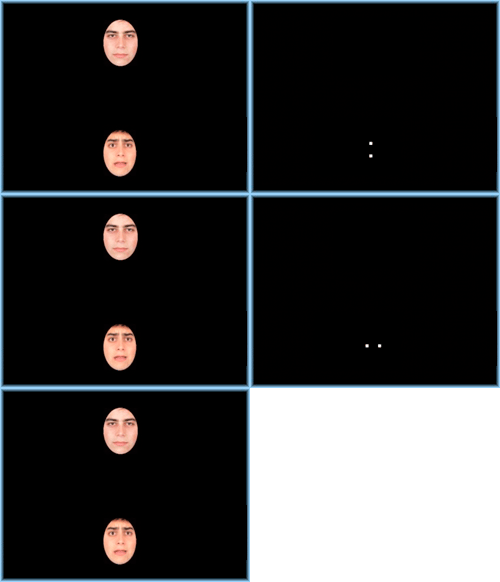
These two papers 1,2 study the effect of oxytocin on attention, as measured by the time taken to identify the orientation of a pattern of dots, appearing from behind one of a pair of images. The researchers interpreted a fast response as demonstrating “vigilance to threat”.
Methods
Design
Both papers are based on double-blind, placebo-controlled, cross-over trials. From reading the methods of each, it appears that both papers describe different sets of results from the same trial. Participants were given oxytocin or placebo by nasal spray 45 minutes before completing the tasks 1,2.
Participants1,2
- 31 patients with a diagnosis of Anorexia Nervosa (AN), currently underweight, recruited from in- and outpatients at Seoul Paik Hospital, South Korea. Diagnoses confirmed by Structured Clinical Interview from DSM-IV
- 33 Healthy Controls (HC), recruited via posters in the psychology department of a women’s university in Seoul
Tasks
Participants completed dot probe tasks (measuring the time taken to identify the orientation of a pattern of dots, appearing from behind one of a pair of images)1,2, to measure their attention to the following stimuli:
- Emotional Faces (showing Anger/Disgust/Happiness) vs. Neutral Faces2
- Eating Related Stimuli (i.e. food) vs. animals1
- Shape Stimuli (“negative” e.g. fat thighs/tummy, “neutral”, e.g. elbows, “positive”, e.g. thin thighs/tummy) vs. animals (“negative”, e.g. snake, insect, “neutral”, e.g. birds, “positive”, e.g. puppies, kittens)1
- Weight Stimuli (e.g. sets of scales) vs. animals1
Participants were then offered a juice drink and asked to drink as much as they could.1
-
Could Oxytocin help people who suffer from Anorexia?
Results
The outcome used in both studies was “Attentional Bias”, calculated as PN (mean reaction time when the dots replaced “neutral” images) minus PE (mean reaction time when the dots replaced other images)1,2. There were many comparisons, both between AN and HC, and between placebo and oxytocin. These were the results:
- There was an interaction between group and drug for angry vs. neutral faces. AN attended less to angry faces than to neutral faces with placebo, and more to angry faces than to neutral faces after oxytocin; the reverse pattern was seen in HC2
- Oxytocin decreased attention to disgusted faces compared to neutral faces in both HC and AN2
- There were no baseline differences in attention towards food in AN versus HC1
- Oxytocin decreased attention towards food compared to animals in both AN and HC1
- Oxytocin decreased attention to “negative” (fat) shape stimuli in AN1
- Oxytocin did not alter the amount of juice consumed1.
Comments
The main difficulty I had with the study was in interpreting the meaning of “attention”. To my mind, it might mean at least two things: (1) I like the look of that, or (2) that seems threatening, I’d better keep an eye on it. So faced with a picture of a delicious/horribly fattening cream cake on one side, and a little kitten on the other, do participants focus on the cream cake because they’re a bit peckish and rather fancy it for tea, or because they’re horrified by the effect it might have on their thighs? It might be that no difference was found between groups in attention to food because both groups were attending to the food images, but for different reasons.
There is an obvious temptation in an early study like this to make multiple comparisons to try to understand how oxytocin might affect different tasks, but I was a little concerned by the number of comparisons, increasing the likelihood of finding a difference between groups by chance. There were so many comparisons that in my description of the results I have not listed all the negative findings. The researchers have chosen to publish the results, which appear to use exactly the same group of patients, as two separate papers, perhaps to enable more detailed and relevant introduction and discussion sections. It is unfortunate that the papers do not reference each other, so a reader of one of the papers would not necessarily be aware of the other paper and the further comparisons between groups.
The authors note that their patient sample was heterogenous1,2 , containing some inpatients and some outpatients, which might make results harder to interpret. The number of participants in the trial was fairly small, and we do not know whether results in South Korean patients would translate to UK patients.
So does the “love hormone” save the day, or has the story been oversold? It will be interesting to see how trials of Oxytocin for AN proceed, and whether it will ultimately be used as a drug treatment for eating disorders, but I am not sure that the results of this trial bring us much closer to knowing whether it might be effective. Trials studying whether oxytocin has an effect on the core symptoms of AN would be more useful from this point of view. The press coverage raises the profile of research into treating mental illnesses, which is positive. However, the reality, which the researchers acknowledge in the original papers, but which is largely ignored in the press coverage, is that we’re some way from that point at the moment.

Links
- Kim YR, Kim CH, Cardi V, Eom JS, Seong Y, Treasure J. Intranasal oxytocin attenuates attentional bias for eating and fat shape stimuli in patients with anorexia nervosa. Psychoneuroendocrinology. Mar 13 2014.
- Kim YR, Kim CH, Park JH, Pyo J, Treasure J. The Impact of Intranasal Oxytocin on Attention to Social Emotional Stimuli in Patients with Anorexia Nervosa: A Double Blind within-Subject Cross-over Experiment. PLoS One. 2014;9(3):e90721.





Lucy Riddett
10 years agoJune Dunnett
10 years agoNicola Davies
10 years agodrbould
12 years agoIain_caldwell
12 years agoDrFulli
12 years agogetwellbeing
12 years agoaat_cat
12 years ago10womenaweek
12 years agoemmacstephen
12 years ago121Therapy
12 years agothesadester1
12 years agoNomNomHelp
12 years agoJGuimond
12 years agoMental_Elf
12 years agoSnowdropDoula
12 years agoSnowdropDoula
12 years agoDrugRehab_org
12 years agotombssimon
12 years agoLizHughesDD
12 years agoSameiHuda
12 years agoBPSOfficial
12 years agoBABCP
12 years agolady_abs
12 years agoMental_Elf
12 years agoThe Mental Elf
12 years agoBwoodHighland
12 years agoNicola Davies
12 years agoheidi_irmeli
12 years agoMental_Elf
12 years agoNessMonster88
12 years agocinders91
12 years agoHerne_TheHunter
12 years agomrsjotaylor
12 years agoThatNeilMartin
12 years agoBrideyMonger
12 years agoBPSOfficial
12 years agoMental_Elf
12 years agoBABCP
12 years agoaghoury79
12 years agoJune Dunnett
12 years agoEmmaLNielsen
12 years agoLynneJ_P
12 years agoMarcusMunafo
12 years agoMental_Elf
12 years agoag2460
12 years agocarrieloujones
12 years agoLucy Riddett
12 years agocariad_mawr
12 years agoJBueno_UKCP
12 years agoEPettz
12 years agoHartlepoolMind
12 years agoBABCP
12 years agofield_matt
12 years ago121Therapy
12 years ago