



Addiction is often viewed as a chronic relapsing disease with a large burden on society.
It is estimated that two million people in the UK are currently suffering from an addiction of some sort including smoking, alcoholism and dependence on illegal drugs.
Impaired inhibitory control
Effective inhibitory control is required in everyday life, such as when we must withhold the expression of socially inappropriate thoughts or behaviour in a given situation. In the context of substance use, impaired control leads to using more of a substance than intended, and failed attempts to control use. These impairments in inhibitory control are reflected in the DSM-5 criteria for substance use disorders (American Psychiatric Association, 2013).
Many studies have investigated inhibitory control in various addicted populations, including behavioural addictions such as gambling and internet addiction. Results, of these studies, however, are inconsistent and sample sizes usually small. Therefore, the recent meta-analysis performed by Smith and colleagues (2014) is very welcome to resolve the current inconsistencies in the field.
Measuring inhibitory control
Like many other cognitive functions, inhibitory control is most commonly measured using computer tasks. The essential aspect of inhibitory control tasks is that participants are asked to respond as quick as possible to certain stimuli appearing on the screen (e.g., a letter or shape) to induce an automatic response tendency. Under certain infrequent conditions (e.g., different letter or shape or when hearing a tone) participants are unexpectedly asked not to respond so that inhibition of the automatic response is required.
Two different computer tasks called the Go-NoGo task and the Stop-Signal task are most commonly used to measure inhibitory control. While both tasks reflect inhibitory control, there is a difference in the exact aspect of inhibitory control that is measured with these tasks. While the Go-NoGo task measures withholding a response that is has not yet been initiated, the Stop-Signal task involves the cancellation of a response that is already underway.
To compare this with concrete addictive behaviour one can think of inhibitory control in a Go-NoGo task as the inability to inhibit lighting another cigarette when a smoker finishes a cigarette (i.e., the inability to inhibit automatic behaviour). Inhibitory control in a Stop-Signal task would be more closely related to the inability to smoke a cigarette once the sequence of behaviour that will result in smoking has been started such as buying a package of cigarettes.

Methods
The authors conduced a literature search in bibliographic databases. In order to be included in the meta-analyses, studies had to compare a drug-dependent or heavy-user group to a control group. Studies reporting results in gamblers and internet addicted individuals were also included. Regarding the Go-NoGo task, the authors also included studies in which the inhibitory load is very low or absent. That is, 50% of the stimuli had to be inhibited. Given that there is a debate in the literature about whether or not this requires sufficient inhibition to be interpreted as inhibitory control (Aron et al. 2014), results of these studies will not be presented here. Go-NoGo results shown here represent studies in which inhibition was rare resulting in sufficiently high inhibitory requirements.
The authors identified 37 papers using a Go-NoGo task with rare inhibition and 47 papers reporting results from the Stop-Signal task. Included papers were published between 1998 and 2014. Analyses were performed separately for the different addicted populations. For some populations there was not sufficient data to perform the mata-analysis.
Results
- Reduced inhibitory control on either the Go-NoGo, Stop-Signal task or both, was observed for cocaine, MDMA, methamphetamine, tobacco, alcohol (dependence and heavy drinking) and gambling
- Cannabis users didn’t show reduced inhibitory control
- There is a lack of data in opioid dependent patients
- Internet addiction seems to be characterized by facilitated inhibitory control
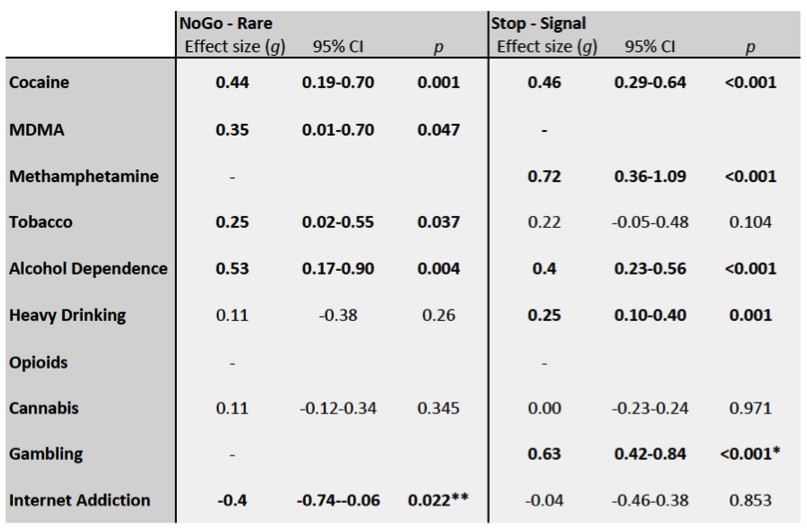
* Given the pattern of results on different outcome measures such as general response time, it may be that impairments in inhibitory control are associated with more general information processing deficits.
** Note that this result suggests facilitation of inhibitory control in internet addiction.

Conclusions
This meta-analysis showed impairments in inhibitory control in various addicted populations compared to controls. Results in cannabis users differ from other addicted populations as no deficits in inhibitory control were found in this group. Additionally, internet addicted populations were characterized by increased inhibitory control.
The authors conclude that:
The results are generally consistent with the view that substance use disorders and addiction-like behavioural disorders are associated with impairments in inhibitory control.
Whilst these results seem promising, it is important to note that effect sizes are small to medium and that the number of included studies for some addicted populations is small, with a minimum of two included studies for internet addiction.

Strengths and limitations
A meta-analysis in this field was badly needed. Conducting separate meta-analyses for the different addicted populations is both a strength in terms of specificity of the findings as well as a limitation, as the number of included studies is rather small for some analyses. Furthermore, many questions remain unanswered such as the crucial question whether impairments in inhibitory control represent a vulnerability factor for substance use, or rather a consequence as a result of neurotoxity.
Summary
These findings of impaired inhibitory control in addition can impact clinical practice in several ways:
- First, it can be included in psycho-education for relatives. While it is hard to understand the choices made by addicted individuals, it may help if relatives realise that a lack of control over behaviour is a core symptom of addiction and not necessarily an indication of a lack of motivation to change.
- Additionally, recent evidence (Jones & Field, 2013) suggests that computer tasks involving adapted versions of the Go-NoGo and Stop-Signal task may be used to train inhibitory control, which may eventually reduced addictive behaviours.
- More research is needed before these trainings can be implemented on a larger scale.

Links
Smith, J.L., Mattick, R.P., Jamadar, S.D. & Iredale, J.M. (2014) Deficits in behavioural inhibition in substance abuse and addiction: A meta-analysis. Drug and Alcohol Dependence, 145, 1-33. [PubMed abstract]
American Psychiatric Association (2013) DSM-5. Diagnostic and Statistical Manual of Mental Disorders, fifth ed. American Psychiatric Publishing, Arlington, VA.
Aron, A.R., Robbins, T.W., Poldrack, R.A. (2014) Inhibition and the right inferior frontal gyrus: one decade on. Trends in Cognitive Sciences, 18, 177-185. [PubMed abstract]
Jones, A., Field, M. (2013) The effects of cue-specific inhibition training on alcohol consumption in heavy social drinkers. Experimental and clinical psychopharmacology, 21, 8-16. [PubMed abstract]





CheapTobaccoINC
11 years agoLuijtenMaartje
11 years agoCastleCraig
11 years agoacaringmind
11 years agokentsecularaa2
11 years agoLuijtenMaartje
11 years agoSubMisuseGcu
11 years agocounsellorlaura
11 years agoCRI_Tweets
11 years agoOPGSPsychology
11 years agoacaringmind
11 years agoEPGnewsandviews
11 years ago121Therapy
11 years agoMental_Elf
11 years agoJayDuckworth
11 years agoMccawleyJ
11 years agoLexxxVink
11 years agoajj_1988
11 years agoajj_1988
11 years agoVFlaudias
11 years agoFirefly_fan
11 years ago121Therapy
11 years agodingy911
11 years agoMental_Elf
11 years agoaghoury79
11 years agojeaninedok
11 years agoLuijtenMaartje
11 years agoAllenFrancesMD
11 years agoLuijtenMaartje
11 years agoNeuroKneel
11 years agominzlicht
11 years agoMental_Elf
11 years agobaclofenews
11 years agobaclofenews
11 years agomvugt
11 years agoEricaEassom
11 years agoian_hamilton_
11 years agoRolfZwaan
11 years agoLuijtenMaartje
11 years agocaputpurgijs
11 years agoPsycLib_UEL
11 years agoMental_Elf
11 years agorojconway
11 years ago'Sue Mario
11 years agoThe Mental Elf
11 years ago7b83u402x8
11 years agoMental_Elf
11 years agoMental_Elf
11 years agoChristina Armstrong-Graham
11 years agoLucy Riddett
11 years agoChristina Armstrong-Graham
11 years agoLuijtenMaartje
11 years agofield_matt
11 years agoagulbranson
11 years agomusazamam
11 years agohughesy9000x
11 years agoMentalWealth123
11 years agoUWSMichaelF
11 years agosanthi_80
11 years agoaghoury79
11 years agoian_hamilton_
11 years agoLuijtenMaartje
11 years agoLuijtenMaartje
11 years ago