

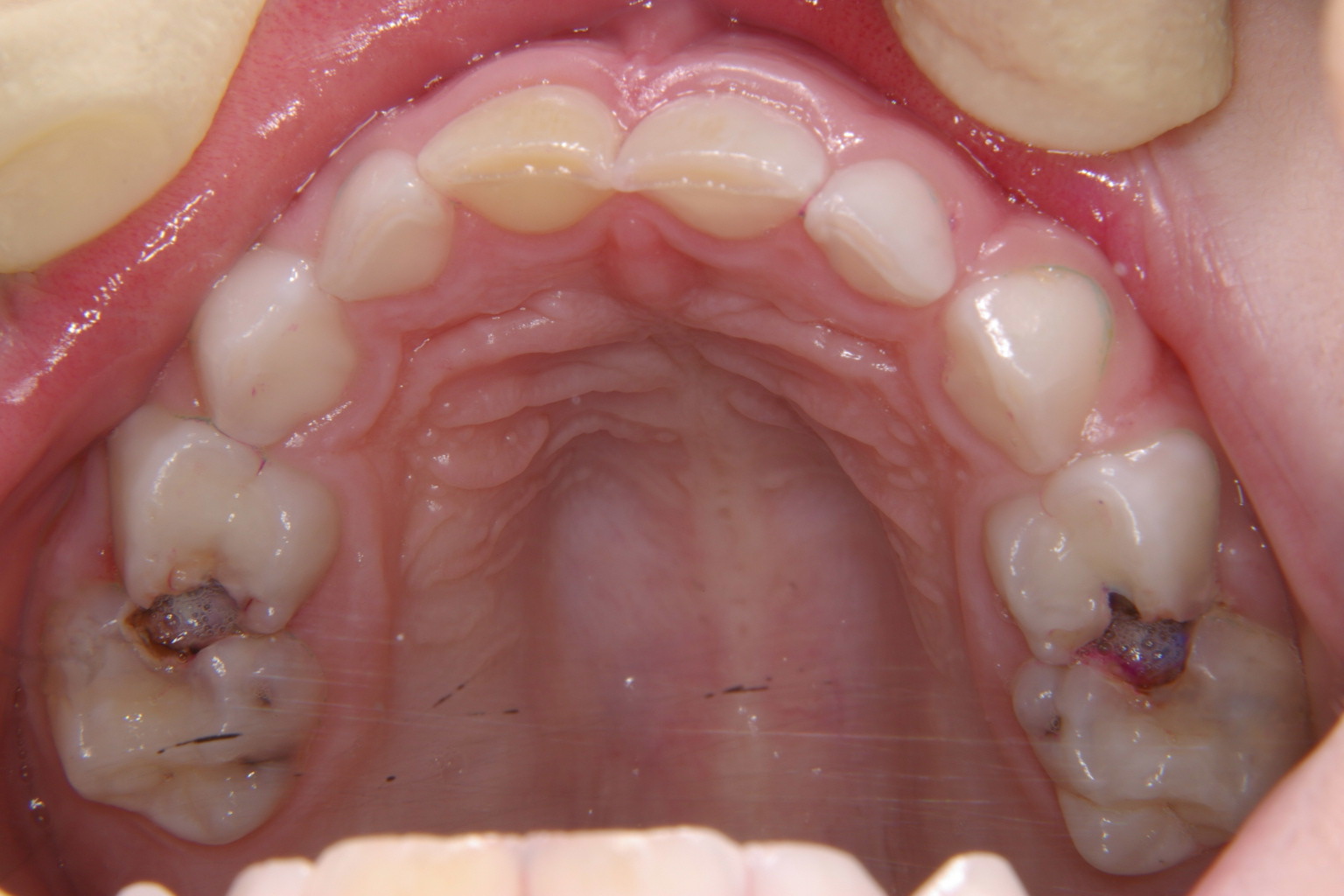

The aim of this study was to compare 24-month pulp health outcomes of partial caries removal (PCR) and total caries removal (TCR) with composite restoration in primary molars.
Children (3–8 years), in good general health and amenable to treatment, with at least one molar with acute, deep carious lesion into dentine were included. The teeth should not be sensitive, have signs of inter-radicular radiolucency or other radiographic signs indicative of pulp necrosis, swell or fistula.
All treatment was carried out under rubber dam. Caries was removed from the lateral walls of cavities in both PCR and TCR groups before caries removal on the pulpal wall. For teeth in the TCR group absence of caries was confirmed after removal of all softened dentine using a blunt-tipped probe. In PCR group excavation was stopped when hardened, dried dentine with a leathery consistency was achieved. Cavities were lined with calcium hydroxide and filled with composite. When caries removal resulted in pulp exposure; pulpotomy was performed with ferric sulphate. A single blinded examiner assessed outcomes. The presence of a fistula, swelling, spontaneous pain and mobility not compatible with root resorption were considered to be clinical signs of failure. The presence of radiolucency at the furcation or in the periapical region and internal or external pathological resorption were considered to be radiographic signs of failure.
- 124 teeth in 51 patients were randomised; 41 patients – 57 teeth in TCR group and 38 patients – 67 teeth in the PCR group.
- 3 patients (4 teeth; 1 PCR and 3 TCR) dropped out leaving 120 teeth (PCR: n = 66; TCR: n = 54) for analysis
- Pulp exposure occurred in 15 (27.5%) teeth from 13 children allocated to TCR and in 1 (2%) tooth from 1 child allocated to PCR (p < 0.01).
- The mean operative time was significantly higher for TCR (28.1 min; 95% CI: 23.6–32.6 min) than for PCR (17.9 min; 95% CI: 16.3–19.5 min).
- At 24 months the success rate was
- Overall 94%; (95% CI: 87–97%)
- TCR group 96%; (95% CI: 85–99%)
- PCR group 92%; (95% CI: 81–96%)
- There was no statistical difference between the groups ( p=0.34)
The authors concluded
The clinical and radiographic success rates of PCR and TCR in primary teeth with deep carious lesions were high and did not differ significantly, indicating that PCR is a reliable minimally invasive approach in primary teeth and that the retention of carious dentin does not interfere with pulp vitality. Moreover, PCR provided other clinically relevant advantages over TCR, especially lower incidence of pulp exposure and lower operative time
Comment
There is increasing interest in stepwise or partial excavation for the management of dental caries. The recent update of the Cochrane review by Ricketts et al (Dental Elf 11th April 2013) concluded that
Stepwise and partial excavation reduced the incidence of pulp exposure in symptomless, vital, carious primary as well as permanent teeth.
This study would appear to support that view as there is a much smaller proportion of pulpally exposed teeth in the TCR group.
Links
Franzon R, Guimarães LF, Magalhães CE, Haas AN, Araujo FB. Outcomes of One-Step Incomplete and Complete Excavation in Primary Teeth: A 24-Month Randomized Controlled Trial. Caries Res. 2014 Apr 8;48(5):376-383. [Epub ahead of print] PubMed PMID: 24732081.
Franzon – Outcomes of One-Step Incomplete and Complete Excavation in Primary Teeth




Claudia Cunningham
10 years agoAlonso Carrasco
10 years agoHani Darwich
12 years agoHani Darwich
12 years agoAlonso Carrasco
12 years agoClaudia Cunningham
12 years agoMarcTennant
12 years agozbysfedo
12 years ago