

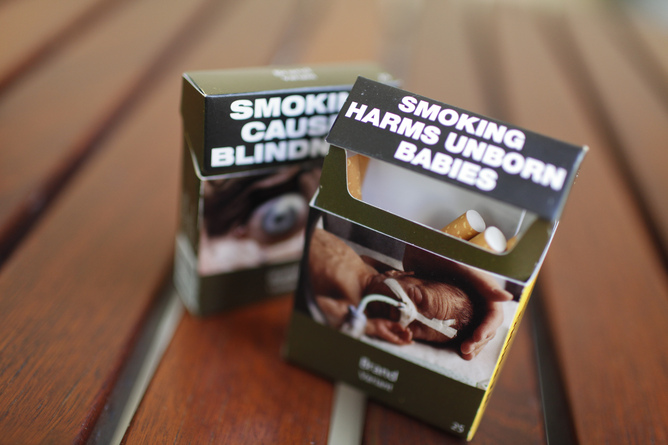


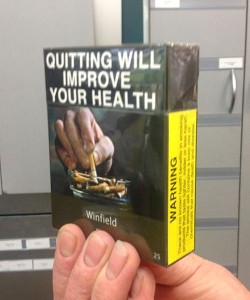
Standardised (or ‘plain’) packaging of cigarettes requires all branding to be removed, leaving the brand name to be placed in a standard location and font on a standard colour cigarette pack. Apart from the small brand name, the packs would still feature a prominent health warning as well as counterfeiting marks.
The aim of standardised packaging is to prevent uptake of smoking, particularly among young people and encourage smoking cessation among current smokers. Australia became the first country in the world to introduce standardised packaging, in December 2012.
The UK government are considering introducing standardised packaging, and in 2012 ran a lengthy public consultation on the issue. A systematic review of the evidence for standardised packaging, commissioned by the Department of Health, and conducted by researchers who are part of the Public Health Research Consortium, was submitted to this consultation (Moodie et al, 2012). This review concluded that there was ‘strong evidence’ to support standardised packaging.
However, the story is not that simple, and the four major transnational tobacco companies (TTCs) (British American Tobacco, Imperial Tobacco, Japan Tobacco International and Philip Morris), who strongly oppose standardised packaging legislation also submitted reviews of the evidence to the consultation. Totalling 1,521 pages overall, these responses were just four of the 2,444 detailed responses submitted to the consultation. The Department of Health report on this consultation, which was not published until 11 months after the end of the consultation period, stated that the government would wait for emerging evidence from Australia (Department of Health, 2013).

Normally, tobacco control policies are protected from the vested interests of TTCs by the Framework Convention on Tobacco and Control (FCTC), which has been signed by over 180 countries around the world, including the UK. However, public consultations in the UK are also governed by a piece of legislation called Better Regulation, a key feature of which is to include businesses and other vested interests in the process of public policy-making. There was therefore a clear tension between the FCTC and Better Regulation when it came to this public consultation.
A paper recently published in BMJ Open by researchers at the University of Bath, part of the UK Centre for Tobacco and Alcohol Studies (UKCTAS) has investigated the ways in which the four largest TTCs used the Better Regulation framework to influence the government’s decision on standardised packaging (Hatchard et al, 2014). Hatchard and colleagues compared the evidence submitted to the consultation by the TTCs and that submitted by the researchers from Public Health Research Consortium in their systematic review. The evidence from both groups was assessed for its policy relevance and its quality.
Methods
The researchers only analysed evidence which supported the claim that standardised packaging ‘won’t work’ (other evidence addressed the concern that standardised packaging would have other unintended consequences, or that the policy process itself was flawed). The authors categorised the evidence presented in both the TTCs responses and the systematic review according to the following criteria:
- The subject matter of the evidence, to assess whether it was relevant to the policy. Evidence was considered relevant if it focussed on standardised packaging and parallel if it focussed on other tobacco issues, or issues unrelated to tobacco.
- The independence of the evidence, as a measure of its quality. Given the vested interests of the TTCs in preventing standardised packaging policies, research was considered independent if it was not tobacco industry funded or linked.
- The peer-review status of the evidence as a second measure of its quality. Peer-reviewed articles, which appear in peer-reviewed journals have been shown to be of better quality to other research outputs.

Results
In total, the TTCs submitted 143 pieces of evidence to the public consultation, 77 of which addressed their concern that standardised packaging ‘won’t work’. The systematic review of the evidence included 37 studies, each of which addressed the effects of standardised packaging.
-
Subject matter
- While 17 out of the 77 pieces of evidence submitted by the TTCs directly addressed standardised packaging
- All the evidence in the systematic review did
- Independence
- Of the 17 pieces of TTC evidence addressing standardised packaging, 14 were industry funded
- None of the evidence in the systematic review was industry funded
- Peer-review
- None of the 17 pieces of TTC evidence addressing standardised packaging was peer-reviewed
- Whilst 21 of the 37 studies in the systematic review were
The 17 pieces of TCC evidence addressing standardised packaging were therefore shown to be of lower quality (in terms of both independence and peer-review status) than the 37 pieces of evidence in the systematic review.

Conclusions
There are three main findings of this analysis:
- The TTCs submitted a large volume of evidence, but only a minority actually focussed on standardised packaging itself, and most of this had a link to the tobacco industry. The authors state that the volume of the TTC evidence submitted to the public consultation, along with the lack of relevance, and quality of this evidence, may have imposed costs on the Department of Health, possibly contributing to the 11 month delay of the publication of the report on standardised packaging.
- The quality of the TTC evidence on standardised packaging was of lower quality (in terms of both independence and peer-review) than that included in the systematic review. In addition, much TTC evidence was either relevant but lacking in quality, or of higher quality but not relevant. The authors suggest that this higher quality but irrelevant evidence may have been included to add legitimacy to the TTCs arguments.
- Industry funded or linked evidence was less likely to be peer-reviewed than evidence not linked to the industry. In the consultation guidelines, there was no requirement for submissions to declare any conflict of interest, or state whether the evidence was independent from the corporation submitting the evidence. All four of the TTCs submitted industry funded or linked research without explicitly acknowledging this, and this lack of transparency was flagged by the authors as a cause for concern for the policy process.

The authors conclude that the Better Regulation process gives corporations the potential to unduly influence the policy process. Given that the FCTC states that tobacco control policies should be protected from the vested interests of the tobacco industry, the other 177 countries which are signatories to the FCTC should implement clear guidelines on how to deal with TTC submissions to consultations. In order to do this, the authors make two suggestions:
- Conflict of interest declarations for each piece of evidence cited should be made mandatory.
- Policymakers should use the rating framework used in this study (relevance, independence and peer-review status) to evaluate the evidence submitted to consultations in order to prioritise high quality, policy-focussed evidence.
The main limitation of this study, which is acknowledged by the authors, is that only proxy measures of evidence quality (independence and peer-review) were used, rather than a validated quality assessment framework. For example, standards of peer-review can vary, being very stringent or more lenient. However, the authors state that these proxy measures, which do not require scientific expertise or extensive data extraction, are the most appropriate for use by policy makers when assessing the quantity of evidence typically presented to them.

Summary
The TTCs submitted a large volume of evidence to the public consultation on standardised packaging, but much of this was lacking in quality and / or was not relevant to the debate. It therefore should be treated with caution.
Since this consultation, a new independent review of the evidence for standardised packaging was commissioned by the government in November 2013. This review is currently ongoing, led by Sir Cyril Chantler (the Chantler Review). A more recent study by the same research group at the University of Bath, published in PLOS Medicine, suggests that the evidence submitted by the TTCs to the Chantler Review was just as misleading as that submitted to the consultation, and in particular, the companies misquoted standardised packaging studies and changed their main messages.
The outcome of the Chantler review was published today. This report concludes that it is:
Highly likely that standardised packaging would serve to reduce the rate of children taking up smoking and implausible that it would increase the consumption of tobacco.
Today in the House of Commons, the Under Secretary of State for Public Health, Jane Ellison, has stated that Chantler ‘makes a compelling case’ and that it was ‘very likely to have a positive impact on public health’. Ellison reported that she was therefore ‘currently minded to proceed with introducing regulations for standardised packaging’.
Draft legislation will now be drawn up, alongside a final short consultation, with a view to introduce standardised packaging before the next General Election in 2015.
Links
Hatchard, J.L., Fooks, G.J., Evans-Reeves, K.A., Ulucanlar, S. & Gilmore, A.B. (2014). A critical evaluation of the volume, relevance and quality of evidence submitted by the tobacco industry to oppose standardised packaging of tobacco products. BMJ Open, 4, e003757. doi: 10.1136/bmjopen-2013-003757.
Moodie C, Stead M, Bauld L, McNeill A, Angus K, Hinds K, Kwan I, Thomas J, Hastings G, O’Mara-Eves A. Plain Tobacco Packaging: A Systematic Review (PDF). University of Sterling, 2012.
Consultation on standardised packaging of tobacco products: summary report (PDF). Department of Health, Jul 2013.
Ulucanlar S, Fooks GJ, Hatchard JL, Gilmore AB (2014) Representation and Misrepresentation of Scientific Evidence in Contemporary Tobacco Regulation: A Review of Tobacco Industry Submissions to the UK Government Consultation on Standardised Packaging. PLoS Med 11(3): e1001629. doi: 10.1371/journal.pmed.1001629
Chantler, C. Standardised packaging of tobacco: report of the independent review undertaken by Sir Cyril Chantler (PDF). 3rd Apr 2014.
Badenoch, D. Uptake of plain packaging was associated with reduced satisfaction from smoking and increased will to quit. The Lifestyle Elf, 25 Jul 2013.
Featured image of plain packaging: AAP/Lukas Coch.






Leona Allan
10 years agoVincent Blyth
10 years agofelly500
12 years agoCRI_PeerMentors
12 years agoaghoury79
12 years agoDukeAddictions
12 years agoGarySlegg
12 years agowouterhavinga
12 years agokarenwhatever
12 years agodallsop
12 years agobeccymaeso
12 years agotrished
12 years agoMental_Elf
12 years agoVincent Blyth
12 years agoclaimokr
12 years agoLizHughesDD
12 years agoMental_Elf
12 years agoMarcusMunafo
12 years agoMental_Elf
12 years agohelengilburt
12 years agoMental_Elf
12 years agokiran_sj
12 years agoMental_Elf
12 years agoMental_Elf
12 years agopnetworker
12 years agoMental_Elf
12 years agoVince1905
12 years agoJayDuckworth
12 years agoMaxineHoward333
12 years agoMental_Elf
12 years agoUniofBath
12 years agodan_247
12 years agopavlosbob
12 years agobehlibrary
12 years agoOsiris221163
12 years agoMental_Elf
12 years agoUCLHealthPsy
12 years agoMental_Elf
12 years agoScottWatkins100
12 years agohetha2009
12 years agoajj_1988
12 years agoMental_Elf
12 years agoFrancisQuinnUK
12 years agoDECIPHerCentre
12 years agoASH_LDN
12 years agoDBadenoch
12 years agoJacksonvilleEDU
12 years agoMental_Elf
12 years agoMarcusMunafo
12 years agoOliviaMaynard17
12 years agoBristolUni
12 years agoQLDMH
12 years agocscott9808
12 years agox_Alan_Thomas_x
12 years agoCherryMakes
12 years agosoozaphone
12 years agoMegEliz_
12 years agoMental_Elf
12 years agoCCreswell99
12 years agoMarcusMunafo
12 years agoBristolUniPsych
12 years agoVCoathup
12 years agoMegEliz_
12 years agoSallyScientist
12 years agoMegEliz_
12 years agoMental_Elf
12 years agoThe Mental Elf
12 years agoLeona Allan
12 years agoDECIPHerCentre
12 years agoMarcusMunafo
12 years agoaghoury79
12 years agochrisdc77
12 years agoMental_Elf
12 years agolypftlib
12 years agoElly_M
12 years agoSubMisuseGcu
12 years agoOliviaMaynard17
12 years agoNHS_KS
12 years agoOliviaMaynard17
12 years ago