

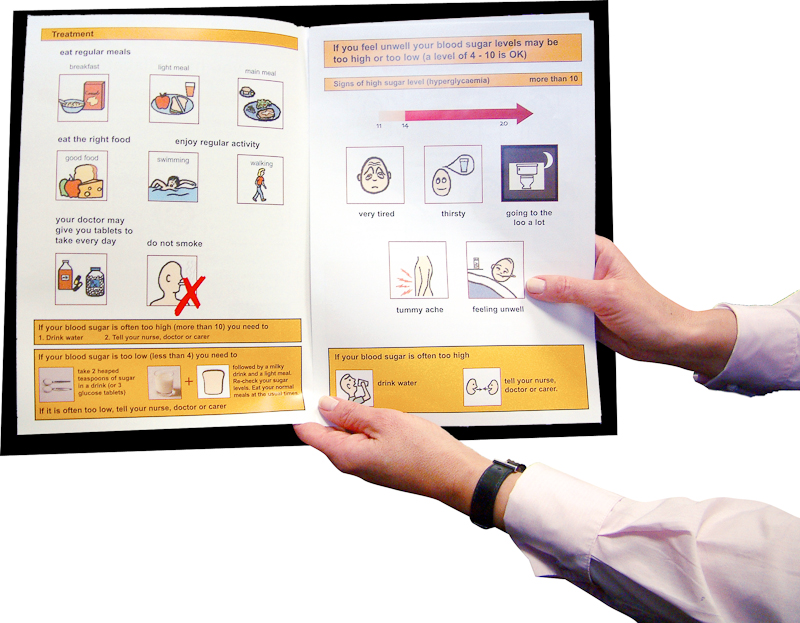

People with learning disabilities have raised risk of a number of health problems and consequently are likely to be on a range of medications, often long term, so it is particularly important that they are given the right support to make their own decisions regarding taking medication, although recent studies suggest that this access to information is not happening.
Studies that have looked at the impact of health information leaflets on the knowledge of people with learning disabilities have suggested that such leaflets did not improve knowledge.
The researchers in this study therefore were interested to look at an alternative way of offering information through the provision of training. They set out to look at the capacity of a small group of people with learning disabilities to make decisions about their medication and to evaluate whether the provision of training (information) sessions on medication to people would increase their capacity.
Method
The research team worked with 28 adults (18 men and 10 women) with a mild to moderate learning disabilities who were currently taking either Metformin (diabetic), Haloperidol (psychotropic) or Epilim (anti-convulsant) medications (but not more than one of these at any one time).
The researchers point out that people were excluded from involvement if they were not able to give consent to taking part in the study.
People who took part were aged between 20 and 56 years.
- 13 lived in supported living settings
- Six in residential homes
- Six with their family
- One lived alone
- One was in a family placement.
The chief investigator on the research team visited people with a community nurse who normally visited, to introduce the project and to give people written and pictorial information about the research. People were given a week to decide if they wanted to be involved.
To gather information, the team used two measures, the ‘British Picture Vocabulary Scale-II (BPVS-II) a standardised measure of language comprehension with 168 words and an adapted ‘Assessment of Capacity Questionnaire’ (A-ACQ) which presented a vignette on the medication the person was taking. This was presented in the first person with pictures to aid understanding. These measures enabled the team to judge whether the person had capacity to consent to their medication
The BPVS-II and adapted ACQ were administered at the first meeting and then the participants competed the A-ACQ for a second time to assess whether having time to consider the information from the first meeting would produce any changes.
Participants were then split into groups, each group with participants taking the same medication.

Each group had three training sessions on their own medications which consisted of information on
- function of medication
- possible side-effects
- risks
- benefits and alternatives to medication
Session one covered the reasons for prescribing the medication, the physiological effects and any possible side-effects.
Session two included a review of positive and negative things that could occur if the individual continued to take their medications.
Session three looked at alternatives available – e.g. avoiding alcohol or flashing lights for those taking antiepileptics.
The training also covered the Mental Capacity Act where it was stressed that each person deemed to have capacity had the right to take or refuse their prescribed medications. The trainers did not give out any information for people to take-home.
Two weeks after the training, the researchers measured capacity again, using the A-ACQ.
Results
Of the 28 people taking part,
- Sixteen (57.1%) participants were taking Epilim,
- Five (17.9%) were taking Haloperidol
Seven (25%) had been prescribed Metformin medications. - They had been taking their medications for an average duration of 8.46 years
The analysis of the correlations between BPVS-II scores and scores on the A-ACQ at baseline (pre-training), first (control) and second re-assessment (post-treatment), showed that the people who had better verbal comprehension were more likely to have capacity to consent to treatment.
However, significant differences on scores on the A-ACQ between baseline and second re-assessment suggested that the training had increased the participants’ knowledge of their medications and consequently had increased their capacity to give informed consent to taking their medication.
They found a weak correlation with participants’ verbal comprehension, suggesting that those with higher verbal comprehension may benefit more from training.
Conclusion and Comment
This study worked with a small number of participants, but the criteria used to judge if a participant had capacity to consent to their medication were quite stringent and the tools used to measure appear to have been appropriately adapted
The provision of information through training in a format that was understandable by people with learning disabilities increased their knowledge. Importantly in the training, people were encouraged to ask questions and seek clarification so it was possible for the trainers to respond to any areas of uncertainty.
Like many people with learning disabilities, the people in this study had been taking their medications for a long time, so in many ways had formed habits around this. The authors suggest that information and training should be offered as soon as possible so that people have the best chance of making their own decisions and to stop situations where people take medication because they have always done so, and without question.
One of the strengths of the study is that it looked at real situations for people, in the first person, rather using third person vignettes and the training focused specifically on improving capacity.
However, it was a small sample, there was no control group and the measures were taken over a short time frame so it may be difficult to generalise from these results with any confidence.
The authors suggest however that the training could be offered to a larger group of participants and that it would be possible, if recruiting from multiple sites, to randomise people to training and no-training groups, and keep raters blind to which groups participants were in. This would increase confidence in the results and also offer the possibility to broaden the range of medications that were involved.
One of the other issues that the authors allude to is the need to offer training on medications to carers, who have reported in several studies, a lack knowledge about medications, why they are prescribed to the people they support and potential side-effects.

Link
Ferguson, L. and Murphy, G. H. (2014), The effects of training on the ability of adults with an intellectual disability to give informed consent to medication. Journal of Intellectual Disability Research, 58: 864–873. [abstract]





Charlotte Bellsie
11 years agoKatherine Baines
11 years agoMaureen Phillip
11 years agoJen Shrek
11 years agoSarah Duffin
11 years agoCatriona Elen McIntosh
11 years agoChris Pendlebury
11 years agoAsh Grayson
11 years agoHDHClinical
11 years agoAsh Grayson
11 years agojane2st
11 years agoSJaneBernal
11 years agoGrainneClose
11 years agoEmergNursesNI
11 years agotristiesarah
11 years agoWilliam_Dunn
11 years agoanniecoops
11 years agoSteveHardyLDN
11 years agoLearningDisElf
11 years agoTabtoob4iPad
11 years agoTabtoob4iPad
11 years agokentautistic
11 years agoMaddenTrevor
11 years agoMaddenTrevor
11 years agolypftlib
11 years agoRoxieaxl
11 years agoLearningDisElf
11 years agoHHLibService
11 years agoCaffeineAndHate
11 years agorhulsw
11 years agoLearningDisElf
11 years agoSarah Duffin
11 years agoCatriona Elen McIntosh
11 years agoChris Tomlinson
11 years agoJen Shrek
11 years agoCharlotte Bellsie
11 years agoKatherine Baines
11 years agoMaureen Phillip
11 years ago