

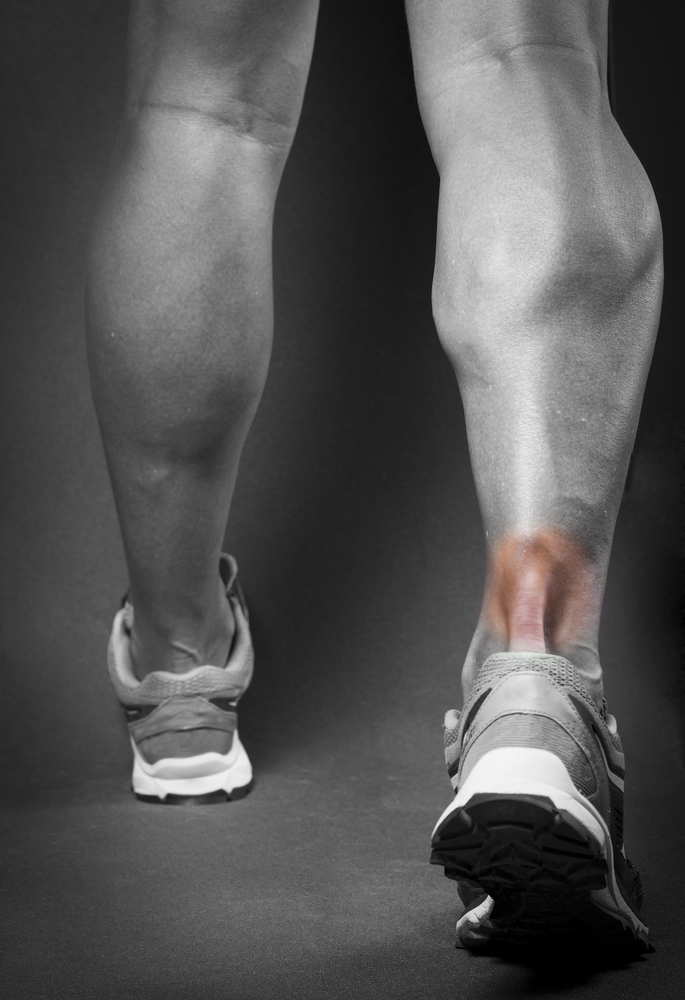

A friend of the Elf has been suffering for some time with pain in the middle of their achilles tendon and as they are usually an active person it has been affecting their function. They have been in the gym undertaking some eccentric exercises (exercises where the muscles are lengthened against a load) but wondered if their programme is most effective.
So we searched the evidence and we found a recent systematic review by Habets and van Cringel that investigated which eccentric exercise training (EET) parameters are most effective for pain and patient-reported function in patients with chronic mid-portion achilles tendinopathy (AT).
Here’s what they did
The authors used a detailed search strategy to search the following electronic databases MEDLINE, EMBASE, CINAHL and Cochrane Central Register for Controlled Trials (CENTRAL) for Randomised Controlled Trials (RCTs) and Controlled Clinical Trials (CCTs) up to February 2013. They also used reference tracking of included studies and other reviews. For adults with chronic (over 3 months) symptoms of mid-portion Achilles tendinopathy.
Three authors independently reviewed, data abstracted and quality assessed each study using the PEDro scale and a score of ≥ 6/10 was considered high methodological quality and 5/10 or lower low methodological quality. Risk of bias was assessed using the Cochrane Collaboration’s tool.
Here’s what they found
- They included 14 studies involving 794 participants (of which 389 received exercise interventions)
- The average age was 32 – 54 years and included athletes and non-athletes
- 6 of the 14 studies were considered high quality
- no uniformity in the exercise protocols was observed
- 3 studies reported good compliance with the exercise programme (75% exercises performed in 26-72% of participants)
- all studies (except one) reported significant improvements for interventions
- As studies used different outcome measures only descriptive analysis was possible
- Pain and function
- Strong evidence for the original Alfredson eccentric protocol (3 high-quality studies)
- Strong evidence (2 high-quality studies) to support the use of a gradual onset of exercises during the first week
- Moderate evidence was found for the different protocols that were used in other 9 studies
The authors concluded
Traditionally, the Alfredson protocol has been used in many studies, but this review showed that other protocols may achieve similar results for pain and function.

The Musculoskeletal Elf’s view

The Alfredson protocol is based on a small prospective study published in 1998 that reported the results of heavy-load eccentric calf muscle training in 15 recreational athletes compared with 15 people treated conservatively. They reported that in no case was the conventional treatment successful, and all patients were ultimately treated surgically. They concluded that the treatment model with heavy-load eccentric calf muscle training has a very good short-term effect on athletes in their early forties. However this study has many methodological weaknesses but the Alfredson protocol appears to be widely used in clinical practice. Therefore this systematic review sought to investigate the effects of different protocols for this patient group on pain and function.
The different outcome measures used by the studies included in this systematic review meant that meta-analysis was not possible. Several studies included in this systematic review used the VISA-A scale (Victorian Institute of Sport Assessment-Achilles Questionnaire). This is an easily self-administered questionnaire that evaluates symptoms and their effect on physical activity and has good validity and reliability.
What do you think?
- If you use the Alfredson protocol do you use the original or a modified version?
- What eccentric exercise training protocol do you use for this population?
- How much resistance, how many reps, bent or straight knee, what speed, how many sessions?
- How do you assess the outcome of treatment for this population?
Send us your views on this blog and become part of the ever expanding Musculoskeletal Elf community. Post your comment below, or get in touch via social media (Facebook, Twitter, LinkedIn, Google+).
Links
- Habets B, van Cingel RE. Eccentric exercise training in chronic mid-portion Achilles tendinopathy: a systematic review on different protocols. Scand J Med Sci Sports. 2015 Feb;25(1):3-15. doi: 10.1111/sms.12208. Epub 2014 Mar 20. [abstract]
- Alfredson H, Pietilä T, Jonsson P, Lorentzon R. Heavy-load eccentric calf muscle training for the treatment of chronic Achilles tendinosis.Am J Sports Med. 1998 May-Jun;26(3):360-6. [abstract]
- Robinson JM, Cook JL, Purdam C, Visentini PJ, Ross J, Maffulli N, Taunton JE, Khan KM; Victorian Institute Of Sport Tendon Study Group. The VISA-A questionnaire: a valid and reliable index of the clinical severity of Achilles tendinopathy. Br J Sports Med. 2001 Oct;35(5):335-41. [abstract]
- PRISMA statement
- EQUATOR Network
Acknowledgements
This blog was written in discussion with the following experienced physiotherapists undertaking an MSc programme at Glasgow Caledonian University; Charlotte Boyer, Elena Ierardi, Beatric Sankah and Ilona Malkauskaite.




Orasa
10 years agoLiza Carless
11 years agoRobert de Zoete
11 years agoFabianguillermo Cevallospenaherrera
11 years agoVicky Ashworth
11 years agoJay McCallum
11 years agoIlona Malkauskaitė
11 years agoLali Jejeia
11 years agoElena E Lorenzo
11 years agoHHLibService
11 years agoStefano Respizzi
11 years agoRachel Dutton
11 years agoLyndsey C Whitson
11 years agoAbiodun T. Adefolarin
11 years agoTracey Shaw
11 years agoGordon Erskine
11 years agoLinzCampbel1
11 years agoSportsInjurySco
11 years agoPhysioUniverse
11 years agoMSK_Elf
11 years ago